

Introduction
Maybe you thought you would know.
Perhaps you expected that if something felt good, you would recognize it immediately. That there would be one clear moment when everything simply made sense.
For many people, that isn’t how a new experience begins.
Instead, they find themselves thinking back over what happened.
Did I miss it?
Should it have felt different?
Why doesn’t my experience seem as clear as everyone else’s?
Questions like these are surprisingly common, especially when something is unfamiliar. They don’t automatically mean something is wrong with your body. More often, they reflect something very human: when we experience something new, we naturally try to make sense of it.
The challenge is that clarity doesn’t always arrive at the same moment as the experience itself.
Sometimes it comes later—after you’ve had time to notice a little more, compare a little less, and become more familiar with your own responses.
You don’t have to decide what every new sensation means today.
For now, it’s enough to simply notice what is already there.
Quick Take
Not knowing exactly what feels good doesn’t automatically mean something is wrong.
Many people expect pleasure to feel immediately obvious, but real experiences are often quieter and more personal than expected. Comfort, curiosity, relaxation, and preference usually become clearer over time rather than appearing all at once.
Instead of searching for one “correct” feeling, try paying attention to how your own experience gradually unfolds.
Quick Answer
There isn’t one universal feeling that everyone immediately recognizes as pleasure.
For many beginners, learning what feels good is less about finding one dramatic sensation and more about becoming familiar with their own responses. New experiences often feel unfamiliar, making them difficult to interpret at first.
That uncertainty doesn’t necessarily mean you’re doing something wrong. It often reflects that you’re still learning to recognize what different experiences feel like for you.
Rather than asking yourself to reach an immediate conclusion, allow yourself to stay curious. Clarity usually develops through observation and experience—not instant certainty.
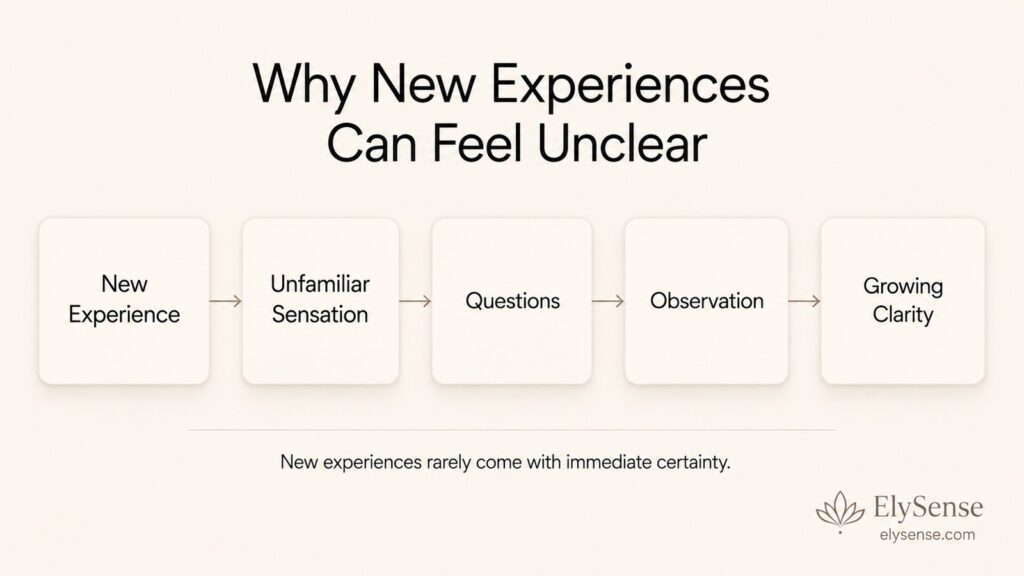
Why New Sensations Can Feel Difficult To Understand
New experiences rarely arrive with clear explanations.
Whenever we experience something unfamiliar, our minds naturally look for certainty.
We compare what happened with what we expected to happen.
We wonder whether we understood it correctly.
Personal exploration is no different.
It’s easy to assume that if something feels good, you’ll recognize it immediately. When that certainty doesn’t appear, many people quickly conclude that something must have gone wrong.
In reality, many new sensations are simply unfamiliar.
Some are subtle.
Some change gradually.
Some become easier to recognize only after you’ve experienced them more than once.
That doesn’t mean your body is responding incorrectly.
It often means your mind is still learning to recognize something it hasn’t experienced before.
Things usually become clearer with experience—not the other way around.
Comparing yourself makes uncertainty feel bigger.
Many expectations come from hearing about other people’s experiences.
Friends, online discussions, social media, movies, and articles often describe experiences after someone already understands them.
You’re reading the finished version of someone else’s story while living through your own beginning.
Is It Normal Not To Like Vibrators?
That’s an unfair comparison.
Instead of asking,
“Does my experience sound like everyone else’s?”
try asking,
“What did I actually notice?”
Perhaps your breathing changed.
Perhaps you felt more relaxed after a few minutes.
Perhaps one sensation held your attention longer than another.
Perhaps you simply became more curious.
These observations may seem small.
They are still valuable.
Instead of comparing your experience with someone else’s description, give yourself permission to become more familiar with your own.
You Don’t Have To Name Every Feeling Right Away
Some sensations stay unclear at first.
It’s easy to believe that if something is meaningful, you’ll recognize it immediately.
But unfamiliar experiences rarely work that way.
Some sensations are obvious.
Others are subtle enough that they only become clearer after you’ve noticed them more than once.
This doesn’t happen because your body is “doing it wrong.”
It happens because your mind is learning to recognize something new.
Think about trying an unfamiliar food for the first time, listening to a style of music you’ve never heard before, or learning a new language.
At first, it can be difficult to describe exactly what you’re experiencing.
As your familiarity grows, details that once seemed difficult to notice often become much easier to recognize.
The same can happen as you become more familiar with your own body.
The sensations themselves may not have changed very much.
Your ability to notice them has.
Not knowing is different from feeling nothing.
One of the most common misunderstandings is assuming that uncertainty means nothing happened.
Those are two very different experiences.
You might not know exactly how to describe what you noticed.
You might not be sure whether a particular sensation was important.
You might simply feel that the experience was different from what you expected.
None of those automatically mean there was “nothing.”
Sometimes the earliest changes are surprisingly quiet.
You may notice yourself relaxing.
You may find it easier to stay present instead of overthinking.
You may realize that slowing down feels more comfortable than rushing.
These observations may not immediately answer the question,
“Did that feel good?”
But they can still help you better understand your own experience.
Not every meaningful experience arrives with a clear label.
Sometimes it begins with quiet curiosity.
Learning To Notice Before You Judge
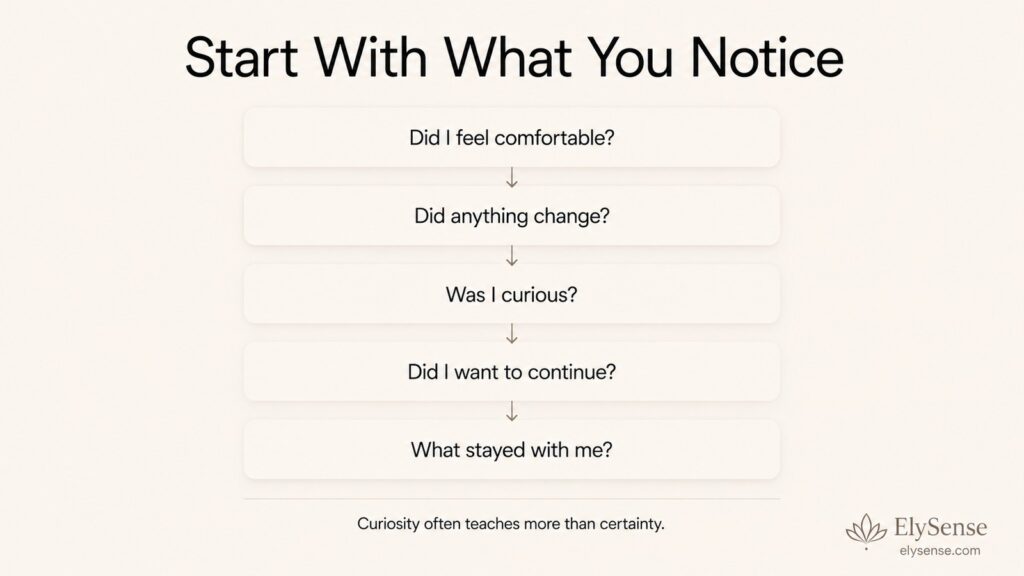
Notice what changes—not what you’re supposed to feel.
Many beginners ask one very big question:
“Did it work?”
The difficulty with that question is that it asks you to judge an entire experience before you’ve had enough time to understand it.
Instead of searching for one final answer, try noticing smaller changes.
For example:
- Did I feel more comfortable than when I started?
- Did my breathing become slower?
- Was there a moment I wanted to continue?
- Did I become more curious as time passed?
- Did anything surprise me?
These questions don’t tell you what you should feel.
They simply help you notice what actually happened.
That small shift often makes it easier to learn from your own experience instead of comparing it with someone else’s.
Describe before deciding what it means.
When something unfamiliar happens, our minds naturally want an explanation.
We want to know whether it was good or bad.
Whether it “counted.”
Whether we did it correctly.
But descriptions are often more helpful than conclusions during the early stages of learning.
Instead of thinking,
“That didn’t work.”
Try noticing,
“I felt more relaxed after a few minutes.”
Instead of thinking,
“I must have done something wrong.”
Try noticing,
“One sensation held my attention longer than another.”
Descriptions leave room for curiosity.
Judgments often close it.
You don’t have to answer every question today.
Sometimes simply describing your experience honestly is enough to help tomorrow make a little more sense.
Questions That Can Help You Understand Yourself
As your experience grows, the questions you ask yourself become just as important as the sensations you notice.
Many people look for one final answer.
“Was that pleasure?”
“Did I finally do it right?”
“Was that supposed to be an orgasm?”
Questions like these can feel overwhelming because they expect certainty before you’ve had enough experience to recognize your own patterns.
Instead, try asking questions that simply help you pay closer attention.
For example:
- Did I feel comfortable?
- Was there a moment I wanted to continue?
- Did anything change as I relaxed?
- Did one sensation hold my attention longer than another?
- What stayed with me after the experience ended?
These questions aren’t trying to judge your experience.
They’re simply helping you notice it.
Over time, those small observations often become much more meaningful than searching for one perfect answer.
How Preferences Become Clear Over Time
Most people don’t discover everything they enjoy in a single experience.
Preferences usually develop gradually.
If you’ve been wondering whether slower progress is normal, you may also find it helpful to read Why Does It Take Me So Long To Orgasm?
As you become more familiar with your own responses, you may begin noticing patterns that repeat.
Perhaps slower pacing consistently feels more comfortable.
Perhaps you discover that certain types of stimulation hold your attention longer than others.
Perhaps your preferences change depending on your mood, stress level, privacy, or energy.
None of those changes mean your body is inconsistent.
They simply reflect something very normal:
people continue learning about themselves throughout life.
Rather than searching for one permanent answer, think of preference as something that becomes clearer through repeated observation.
You don’t need to rush that process.
And you don’t need your experience to look like anyone else’s for it to be meaningful.
When It May Be Worth Looking More Closely
Feeling uncertain is usually very different from feeling concerned.
Uncertainty often becomes smaller as familiarity grows.
Some situations, however, deserve a little more attention.
Consider speaking with a qualified healthcare professional if you consistently experience:
- pain during stimulation;
- sudden changes in sensation that concern you;
- symptoms that continue over time without improvement;
- emotional distress that feels persistent or overwhelming.
Seeking support doesn’t mean something is seriously wrong.
It’s simply another way of taking care of your health.
Most importantly, remember that uncertainty by itself is rarely a warning sign.
Sometimes it’s simply part of learning something new.
ElySense Perspective
You don’t have to recognize every feeling today.
That’s different from having nothing to notice.
Give yourself permission to stay curious.
The rest can come with time.
Frequently Asked Questions
Is it normal not to know what feels good?
Yes. New sensations don’t always come with immediate clarity. Many people gradually become more familiar with what feels enjoyable through repeated experience rather than recognizing everything at once.
Why do my feelings seem different every time?
Your physical and emotional state can influence how an experience feels. Stress, relaxation, privacy, mood, and many other factors naturally affect your responses.
Can pleasure feel confusing at first?
Yes. New experiences often feel unfamiliar before they feel recognizable. That doesn’t necessarily mean anything is wrong—it usually means you’re still learning how to interpret your own responses.
How long does it take to learn what I like?
There isn’t a universal timeline. Some people notice patterns quickly, while others develop a clearer understanding gradually. Both experiences are completely valid.
Does uncertainty mean something is wrong?
Not necessarily. Uncertainty is often part of becoming familiar with something new. However, persistent pain, significant emotional distress, or sudden changes that concern you deserve professional attention.
Should I keep trying if I’m still unsure?
Only if you feel comfortable and genuinely curious. There’s no benefit in rushing toward certainty. Giving yourself time to observe your own responses is often more helpful than trying to force an immediate conclusion.
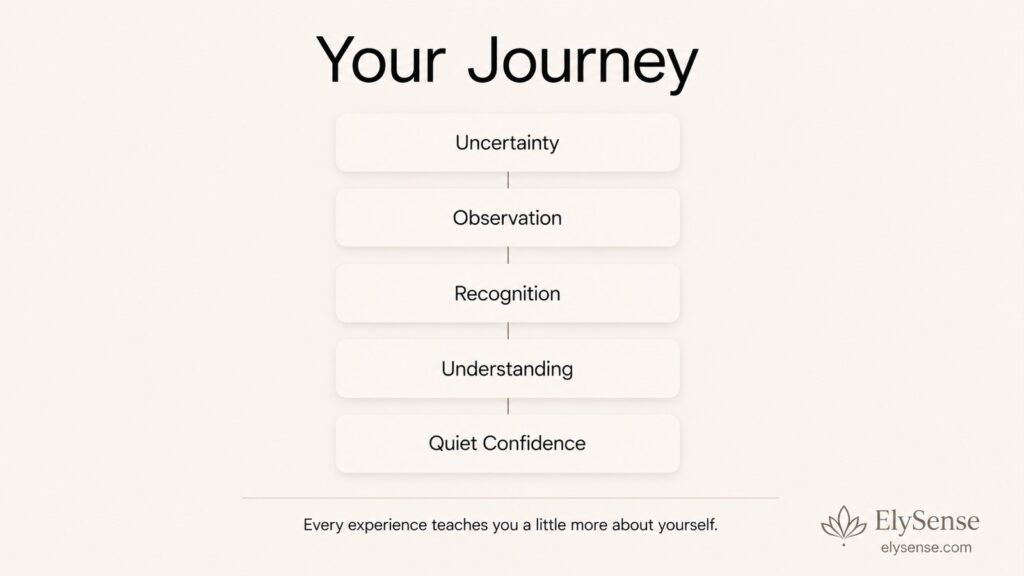
Continue Your Journey
If you’re still asking…
“Am I doing something wrong?”
→ Am I Using My Vibrator Wrong?
If you’re wondering…
“Why doesn’t it feel like everyone else’s experience?”
→ Is It Normal Not To Like Vibrators?
If you’re beginning to notice what works for you…
“Why Does It Take Me So Long To Orgasm?“