

Introduction
You’ve probably heard the advice before.
“There’s nothing wrong with it.”
“Lots of people do it.”
“You shouldn’t feel guilty.”
If you’re still trying to understand your own experience, you may also find How Do I Know What Actually Feels Good? helpful.
Maybe you’ve even said those things to yourself.
And yet, the feeling hasn’t completely gone away.
You may know that exploring your own body isn’t automatically harmful or wrong. You may understand that many people have similar experiences. Part of you may genuinely believe that.
So why does another part of you still feel uncomfortable?
Why can excitement and shame seem to exist at the same time?
Why does your mind say one thing while your emotions seem to say another?
Questions like these are more common than many people realize.
They don’t necessarily mean you’ve done something wrong.
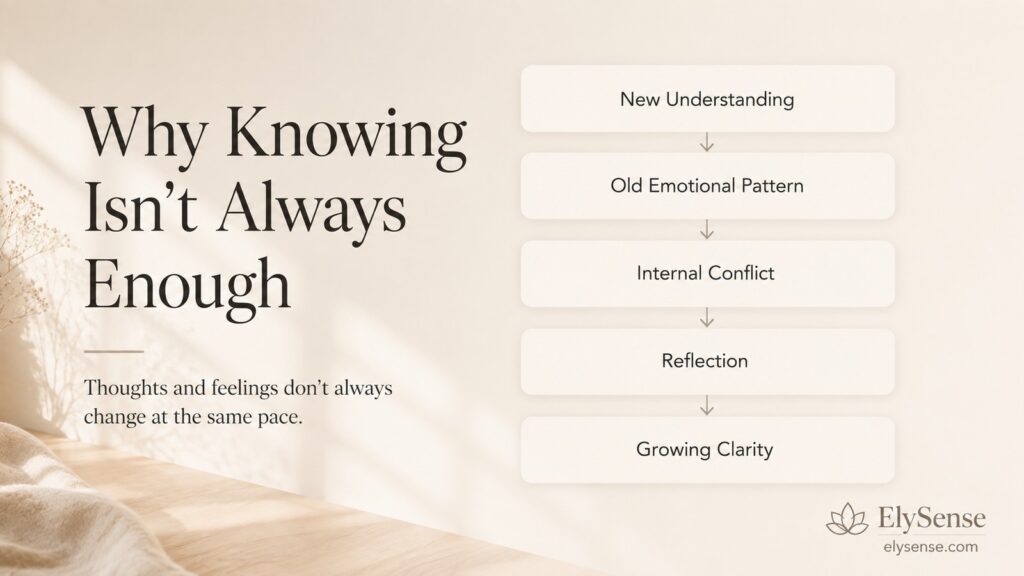
Often, they simply reflect that different parts of our understanding don’t always change at the same speed.
Sometimes our thoughts move first.
Our feelings take longer to catch up.
Before deciding what your guilt means, it may help to understand where that feeling came from—and what it does, and doesn’t, tell you.
Quick Take
Feeling guilty doesn’t automatically mean you’ve done something wrong.
Many people experience guilt even after their beliefs begin to change. That feeling can be influenced by years of family messages, cultural expectations, religious beliefs, or personal experiences.
Rather than treating guilt as immediate proof that you’ve violated your own values, it can be more helpful to become curious about why the feeling is there in the first place.
Quick Answer
Many people assume that guilt works like a warning light.
If they feel guilty, they conclude they must have done something wrong.
Real life is often more complicated.
Our emotions are shaped by many experiences long before we consciously examine them. Sometimes we continue feeling guilty even after our beliefs have started to change. That doesn’t automatically mean those feelings are wrong—or that your current values are wrong.
It simply means that understanding ourselves often takes longer than changing our minds.
Instead of asking,
“How do I stop feeling guilty?”
it may be more helpful to ask,
“What is this feeling trying to tell me—and what assumptions have I already made about it?”
That small shift can open the door to a much deeper understanding of yourself.
Why Knowing Something Is Okay Doesn’t Always Change How You Feel
Most of us like to believe that once we understand something logically, our emotions will quickly follow.
Sometimes they do.
Often, they don’t.
Think about other parts of life.
You might know you’re safe speaking in front of a group, yet still feel nervous.
You might know a mistake from years ago has been forgiven, yet still feel embarrassed when you remember it.
You might know you don’t have to meet everyone’s expectations, yet still worry about disappointing someone you love.
Our emotional responses don’t always update as quickly as our beliefs.
The same can happen when it comes to sexual wellness.
You may genuinely believe that exploring your own body isn’t inherently wrong.
At the same time, another part of you may still carry older emotional messages about what you were taught, what was expected of you, or what kind of person you were supposed to be.
Those experiences don’t disappear overnight simply because you’ve learned something new.
Understanding this difference doesn’t solve every uncomfortable feeling.
But it can help you stop assuming that guilt automatically tells the whole story.
When Old Messages Become Automatic Feelings
None of us begin forming our beliefs in isolation.
Long before we make our own choices, we absorb messages from the people and environments around us.
Some families spoke openly about sexuality.
Others rarely mentioned it.
Some cultures encouraged curiosity.
Others emphasized privacy, modesty, or silence.
Some people grew up with strong religious teachings that shaped how they understood sex and relationships.
Others absorbed quieter expectations without anyone saying them directly.
Over time, repeated messages can become automatic emotional responses.
That doesn’t mean those responses are permanent.
It also doesn’t mean they define what you believe today.
It simply reminds us that emotions often have a history.
Sometimes a feeling isn’t only about what happened today.
Sometimes it’s connected to lessons, expectations, or fears that have been building quietly for years.
Recognizing that possibility isn’t about blaming your family, culture, or faith.
It’s about giving yourself permission to understand your own story with honesty and compassion.
When we feel something strongly, it’s natural to assume the feeling is telling us the truth.
A Feeling Isn’t Always A Conclusion
If we feel afraid, we look for danger.
If we feel embarrassed, we assume we’ve done something embarrassing.
If we feel guilty, we often conclude we’ve done something wrong.
Sometimes those conclusions are accurate.
Sometimes they aren’t.
A feeling is real because you experienced it.
But a feeling isn’t always a complete explanation of why it appeared.
Guilt can be one example.
It may reflect that you’ve acted against your personal values.
It may also reflect habits of thinking that developed long before you consciously chose those values for yourself.
The feeling itself doesn’t immediately tell you which one is true.
That’s why curiosity is often more helpful than immediate judgment.
Instead of asking,
“What does this guilt prove?”
try asking,
“What might this feeling be responding to?”
Those are very different questions.
One searches for a verdict.
The other makes room for understanding.
Separating What You Were Taught From What You Believe Today
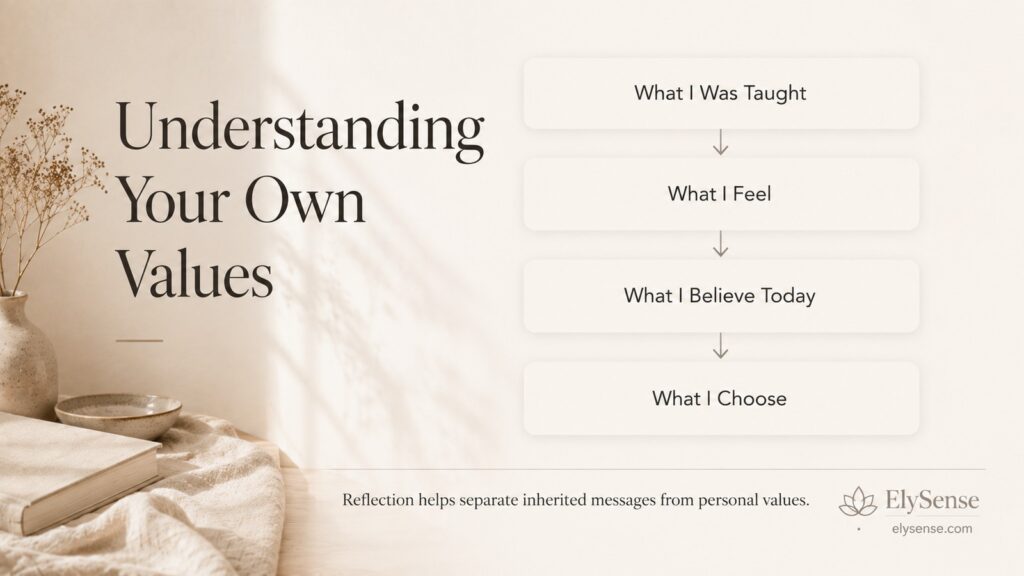
As we grow, many of our beliefs are inherited before they are examined.
Some become lifelong values.
Others gradually change as we gain new experiences.
This isn’t unique to sexuality.
It happens in many parts of life.
The challenge is that emotional responses don’t always update at the same pace as conscious beliefs.
You may have learned messages about modesty, privacy, relationships, or sexual behavior many years ago.
Some of those messages may still feel emotionally familiar today, even if your perspective has become more nuanced.
That doesn’t automatically mean your earlier beliefs were wrong.
It doesn’t automatically mean your current beliefs are wrong either.
It simply means you’re in the process of deciding what truly reflects your own values.
That process often takes time.
It deserves patience rather than pressure.
Choosing Your Values With Compassion
Eventually, many people reach a quieter question.
Not,
“What am I supposed to believe?”
But,
“What do I honestly believe now?”
That answer may be influenced by your personal experiences, relationships, culture, spirituality, or many other parts of your life.
No article can decide those values for you.
And ElySense shouldn’t try.
What we can encourage is something simpler.
Give yourself permission to explore that question honestly.
Notice which beliefs still feel meaningful.
Notice which ones came from expectations you may never have consciously chosen.
Most importantly, remember that reflecting on your values isn’t the same as rejecting where you came from.
For many people, it’s simply part of becoming more intentional about who they are.
When Guilt Feels Too Heavy To Carry Alone
Sometimes feelings of guilt become persistent, overwhelming, or deeply distressing.
If guilt is affecting your daily life, your relationships, or your ability to care for yourself, it may be helpful to speak with a qualified mental health professional or healthcare provider.
This is especially important if your feelings are connected to past trauma, anxiety, obsessive thoughts, or experiences that continue causing significant emotional pain.
Seeking support doesn’t mean you’ve failed to understand yourself.
Sometimes understanding ourselves becomes easier when we don’t have to do it alone.
ElySense Perspective
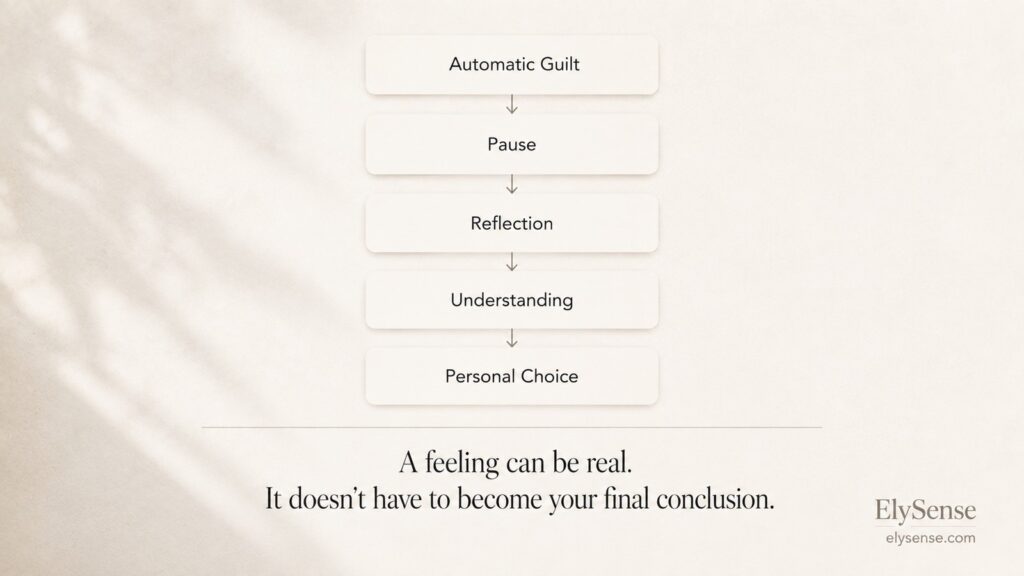
A feeling can be completely real without becoming your final conclusion.
Sometimes the kindest thing you can do is stay curious long enough to understand where that feeling came from before deciding what it means.
Frequently Asked Questions
Is it normal to feel guilty after using a vibrator?
Yes. Many people experience guilt even when they consciously believe self-pleasure is acceptable. Emotions are often influenced by past experiences, family messages, culture, or personal beliefs.
Does feeling guilty mean I’ve done something wrong?
Not necessarily. Guilt tells you that something feels important to you, but it doesn’t automatically explain why the feeling appeared. Understanding the context often matters more than reaching an immediate conclusion.
Why do I still feel ashamed even though I know it’s normal?
Knowledge and emotions don’t always change at the same pace. It’s possible to understand something intellectually while still experiencing older emotional responses.
Can my upbringing affect how I feel about pleasure?
For many people, yes. Family, culture, religion, and early experiences can all influence emotional responses, even as personal beliefs continue to evolve.
How do I know what I truly believe?
That usually isn’t a question with one immediate answer. It often becomes clearer through reflection, experience, and honest self-exploration over time.
Will these feelings ever go away?
For many people, uncomfortable feelings become less intense as they better understand themselves and their values. If guilt remains overwhelming or causes significant distress, professional support can be an important next step.