
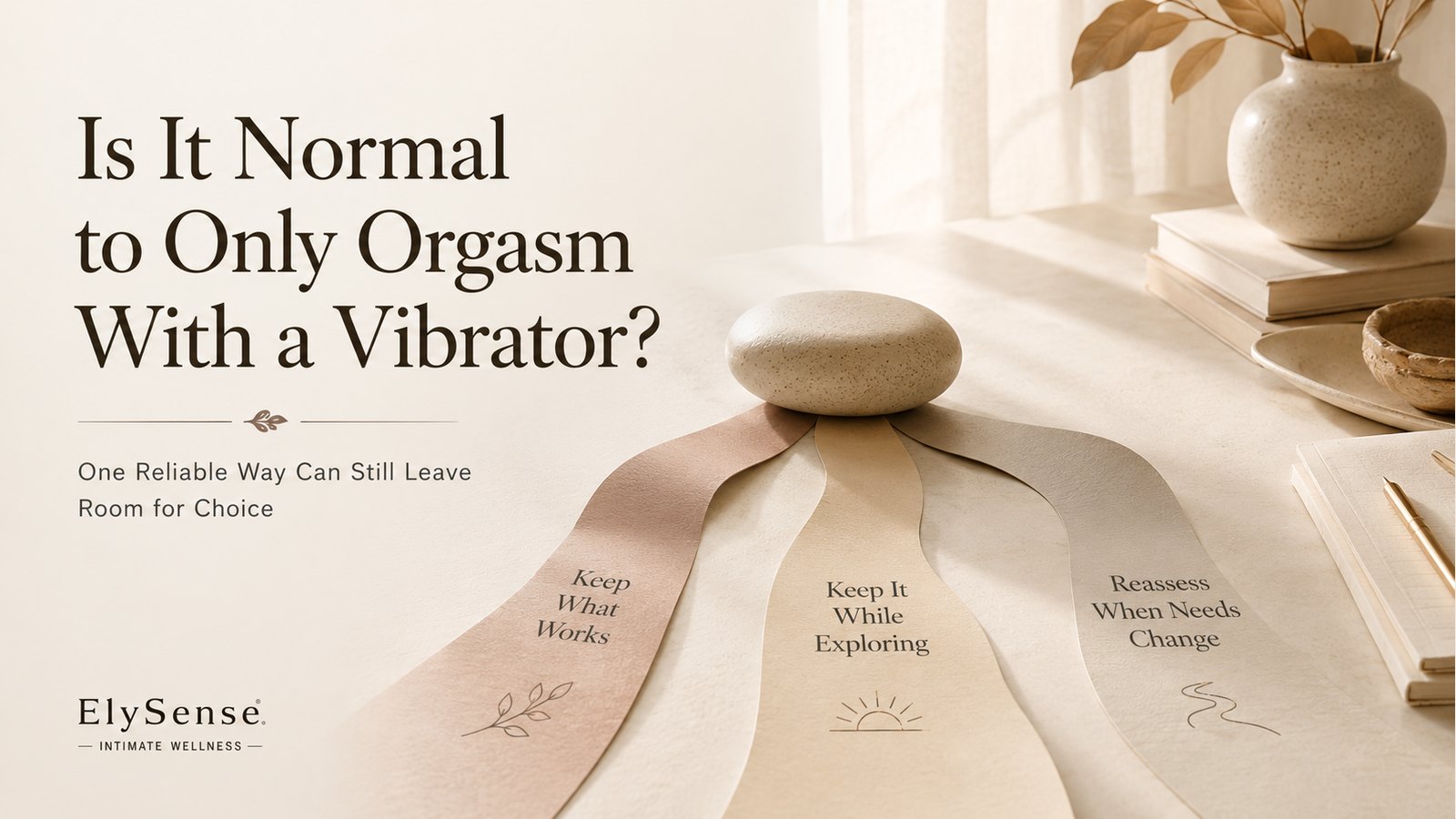
Understanding why one reliable path does not have to become a problem—and how to decide whether you want anything to change.
Maybe you already know what works.
With a vibrator, orgasm feels possible, familiar, and reliable. Without it, the experience may take much longer, feel uncertain, or not lead to orgasm at all.
At first, that reliability may have felt reassuring.
Then comparison entered the picture.
Perhaps you heard that you should be able to orgasm from touch alone. Maybe a partner wondered why the vibrator was necessary. Maybe you started worrying that using it too often had limited your body, made you dependent, or taught you the “wrong” way to experience pleasure.
A reliable method can begin to feel like a restriction.
But those are not the same thing.
The question is not only:
Can I orgasm in another way?
It is also:
Am I actually unhappy with what works—or do I only feel that I should be different?
Quick Take
Only being able to orgasm with a vibrator does not automatically mean something is wrong.
Many people discover one kind of stimulation that works more consistently than others. Reliability is not the same as dependence, damage, or failure.
You may decide to keep doing what works. You may remain comfortable with it while gently exploring other possibilities. Or you may reassess the experience if something has changed or is causing distress.
The important part is that the decision comes from your needs—not from pressure to prove that your body can respond in more ways.
Quick Answer
Yes. It can be normal to orgasm more reliably—or only—with a vibrator.
Bodies do not all respond to the same stimulation in the same way. A vibrator may provide the consistency, intensity, rhythm, or focus that helps you stay engaged and reach orgasm.
That alone does not mean you are unhealthy, dependent, or incapable of enjoying intimacy without one.
You also do not have to stop using what works in order to discover whether something else might work.
Why One Method May Feel More Reliable
Consistency Can Make the Experience Easier to Follow
A vibrator can provide a relatively consistent sensation.
The rhythm does not change unless you change it. The stimulation can remain in the same area. You may have more control over the intensity, position, and duration than you do with other forms of touch.
That predictability can make it easier to remain focused on what feels good.
This does not mean your body has been trained incorrectly.
It may simply mean that you have found an input your body recognizes and responds to reliably.
Familiarity Can Reduce Uncertainty
When you already know what tends to work, you may feel less pressure to monitor every part of the experience.
You do not have to keep wondering:
- Is this enough?
- Should I change something?
- Am I taking too long?
- Is orgasm going to happen?
Familiarity can reduce some of that mental uncertainty.
This matters because pleasure is not only about the strength of a sensation. Attention, comfort, confidence, context, and the ability to remain present can also shape the experience.
A familiar method may make those conditions easier to access.
Different Bodies Prefer Different Kinds of Stimulation
Some people respond more readily to steady stimulation. Others prefer pressure, movement, touch, fantasy, emotional connection, or combinations of several inputs.
There is no rule that says all forms of stimulation should work equally well for one person.
If orgasm feels difficult across many situations—not only without a vibrator—it may help to explore the broader reasons orgasm does not always happen easily.
Having one reliable pathway does not mean the rest of your body is failing.
It means one pattern currently works more predictably than others.
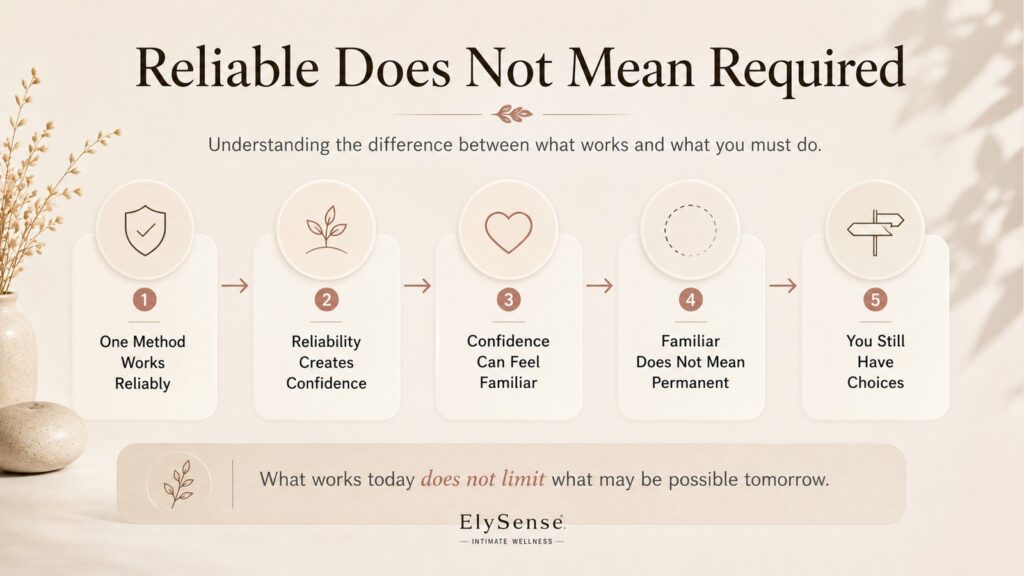
Reliability Is Not the Same as Limitation
It is easy to hear:
This is the only thing that works right now.
and interpret it as:
This is the only thing that will ever work.
But the first statement describes your present experience.
The second predicts your future.
Those are different claims.
Your current reliable method does not define every experience you may have later. At the same time, you do not need to pursue more options simply to make your current experience seem more acceptable.
Why This Can Begin to Feel Like a Problem
External Comparison Can Turn Reliability Into Self-Doubt
You may have been satisfied until you began comparing your experience with someone else’s.
Other people may describe orgasming easily from touch, penetration, partnered sex, or many different kinds of stimulation. Media and sexual advice can make versatility sound like a measure of health, skill, or intimacy.
Then a personal pattern begins to feel like a deficiency.
You may think:
Everyone else has more options than I do.
But another person’s experience is not a standard your body must meet.
The number of ways you can orgasm is not a score.
“Only” Can Carry More Judgment Than Information
The word only can make a reliable experience sound automatically inadequate.
Compare these two statements:
I have one method that works consistently.
I can only orgasm one way.
They may describe the same experience, but they do not carry the same emotional meaning.
The first recognizes reliability.
The second emphasizes lack.
Sometimes the distress comes less from the experience itself and more from the meaning attached to it.
Partner Concerns Can Add Pressure
A partner may worry that the vibrator is replacing them, that they are doing something wrong, or that intimacy should happen without a device.
Those concerns may be emotionally real, but they do not prove that your current orgasm pattern is unhealthy.
A vibrator can be part of partnered intimacy rather than a competitor within it.
The more useful conversation is usually not:
How do we remove the vibrator?
It is:
What helps us both feel included, comfortable, and connected?
Fear of Dependence Can Make You Distrust What Works
When one method is reliable, it is understandable to wonder whether you have become dependent on it.
If the word “dependent” is carrying most of the worry, it may help to look more closely at what vibrator dependence actually means before deciding that reliability is a problem.
But using something consistently because it works is not automatically the same as being unable to make choices.
The more important questions are:
- Do you still feel that the decision belongs to you?
- Are you comfortable with the role it plays?
- Is it causing pain, distress, conflict, or unwanted change?
- Do you want more flexibility, or do you only feel that you should want it?
These questions reveal more than the fact that you use a vibrator frequently.
When Is It Completely Fine?
Your current pattern may not need changing at all.
It may be completely fine to continue if:
- you are comfortable with the experience;
- it is pleasurable rather than painful;
- you do not feel pressured or distressed by it;
- it fits naturally into your solo or partnered life;
- you can choose when you do or do not want to use it;
- and the concern mainly comes from comparison with other people.
You do not need to create a problem simply because your body has found one reliable solution.
Something does not become unhealthy merely because it is consistent.
When Might You Want More Options?
Wanting more flexibility is also valid.
The key distinction is:
Do you want more options—or do you believe you are required to have them?
Exploration is most useful when it grows from curiosity, changing needs, or personal goals.
It becomes less useful when it is driven by embarrassment or pressure.
You Feel Genuinely Curious
You may simply wonder what else your body could enjoy.
Curiosity does not require rejecting your vibrator. You can preserve what already works while learning about other sensations without making orgasm the immediate goal.
The question can become:
What else feels interesting?
rather than:
How do I prove I can orgasm without this?
You Want More Flexibility With a Partner
Perhaps you want your partner to feel more involved. Maybe using the vibrator is sometimes inconvenient, or you would like intimacy to feel less dependent on one particular setup.
Those are reasonable goals.
But flexibility does not have to mean removing the vibrator.
It may mean communicating more clearly, including the vibrator in shared experiences, exploring different roles, or learning what kinds of touch support the sensations you already know you enjoy.
Your Circumstances Have Changed
Life changes can affect what feels convenient, comfortable, or desirable.
Privacy, travel, relationships, physical changes, medication, stress, and access to a particular product may all influence what you want from your sexual routine.
Wanting another option because your situation changed is different from believing your existing method was wrong.
The Current Pattern No Longer Feels Like Your Choice
Sometimes a once-comfortable routine begins to feel rigid.
You may notice that you no longer feel curious, present, or in control. Perhaps you use the vibrator automatically even when you would prefer a different experience. Or you may feel distressed by how strongly orgasm has become tied to one exact setting or routine.
That does not automatically prove dependence.
But it may be worth slowing down and asking whether the current pattern still fits you.
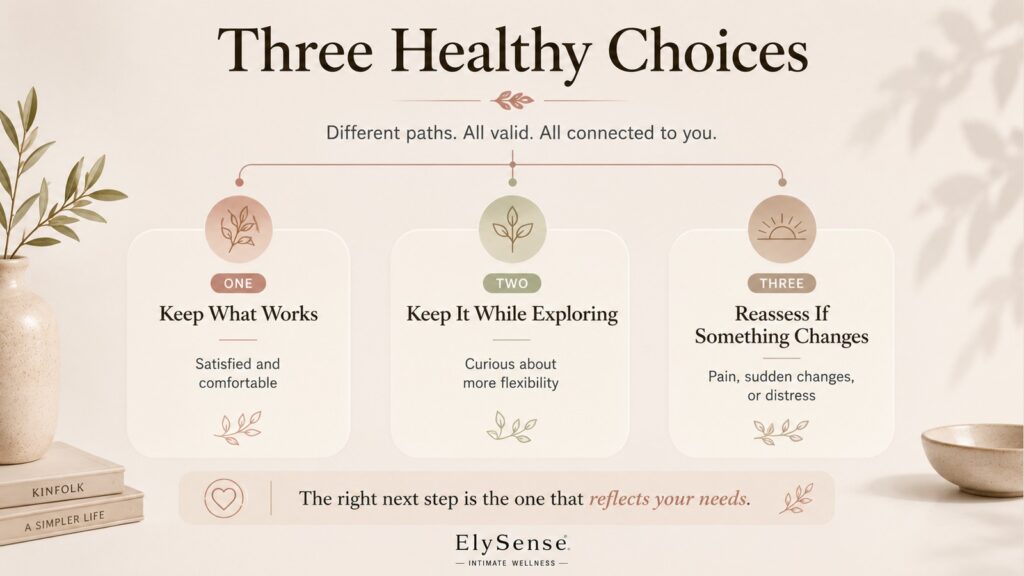
Three Healthy Choices
There is not one correct response to this situation.
There are at least three reasonable paths.
Choice One: Keep Doing What Works
You may decide that you are satisfied.
Your vibrator works reliably. It does not cause pain or distress. It fits your life. You do not genuinely want to change anything.
That is a complete decision.
You do not have to turn every reliable pleasure pattern into a self-improvement project.
Keeping what works can be an informed choice—not avoidance.
This path may fit you if:
- the experience feels comfortable and positive;
- your concern mostly came from comparison;
- you do not feel limited in a way that matters to you;
- and changing the pattern would serve someone else’s expectation more than your own need.
The goal is not to become more versatile for the sake of appearing normal.
The goal is to build a sexual life that feels right for you.
Choice Two: Keep It While Slowly Exploring
You may want more options without giving up your most reliable one.
This is often a gentler path than stopping completely.
You might allow the vibrator to remain part of the experience while noticing:
- what kind of pressure feels good;
- which rhythms your body responds to;
- whether different touch feels better before or after vibration;
- what helps you stay mentally present;
- and whether pleasure can remain meaningful even when orgasm is not the outcome.
You do not need to make the vibrator the enemy.
It can remain a source of reliability while you become curious about other possibilities.
Exploration may involve combining familiar and unfamiliar sensations rather than replacing one with the other.
And progress does not have to mean orgasming without a vibrator.
It may simply mean feeling more comfortable, more connected, or more aware of what your body enjoys.
Choice Three: Reassess If Something Has Changed
A third path is appropriate when the issue is no longer only about preference.
It may be worth reassessing the experience if you notice:
- persistent pain;
- ongoing numbness that does not resolve;
- skin irritation or injury;
- a sudden change in sensation;
- difficulty experiencing pleasure across many situations;
- distress that continues even when external pressure is removed;
- relationship conflict that feels difficult to navigate;
- or changes that appeared alongside medication, hormonal, neurological, or other health symptoms.
Noticing one of these changes does not automatically mean something serious is wrong.
But it may be useful to speak with a qualified healthcare professional who can consider your individual circumstances.
The concern here is not that you use a vibrator.
It is that something about your broader experience has changed, become painful, or is causing meaningful distress.
How to Make the Decision Yours
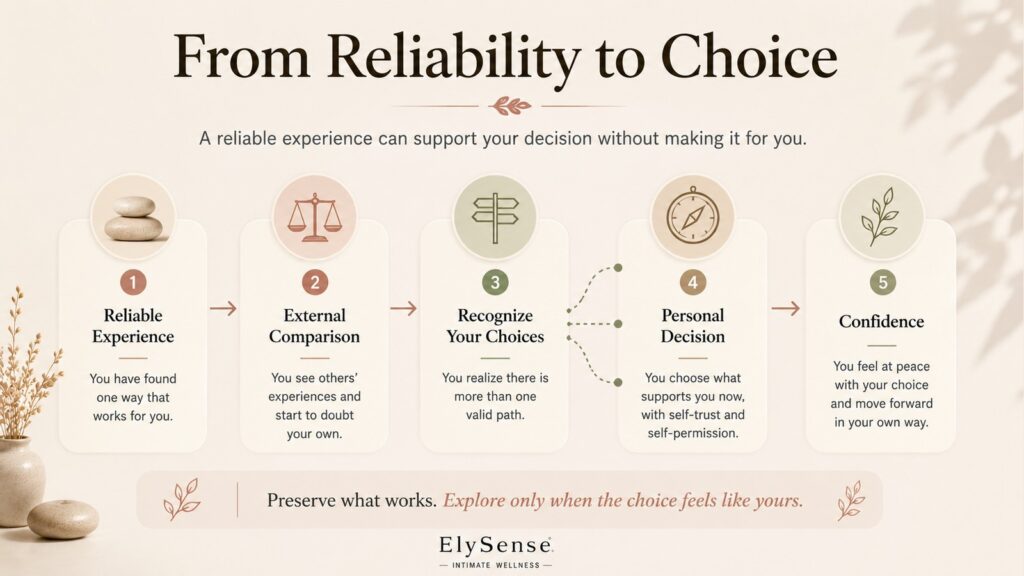
A useful decision does not begin with:
What should a normal person do?
It begins with:
What is true about my experience?
You might ask yourself:
Am I Actually Dissatisfied?
Try to separate your own feelings from outside expectations.
Before someone commented on it—or before you compared yourself with others—did this pattern feel like a problem?
If the answer is no, that information matters.
What Would I Hope to Gain From Changing It?
Perhaps you want curiosity, variety, flexibility, connection, convenience, or a stronger sense of choice.
A clear goal makes exploration more meaningful.
“Be more normal” is not a clear or compassionate goal.
Would Keeping the Vibrator Support or Interfere With That Goal?
In many cases, preserving the reliable method can make exploration feel safer and less pressured.
You do not always have to remove the familiar option to learn something new.
Does the Process Still Feel Voluntary?
Any experiment should remain optional.
You can pause. You can return to what works. You can decide the goal no longer matters to you.
A healthy decision leaves room for revision.
There Does Not Have to Be Only One Right Way
Sexual advice often searches for the correct answer.
Use the vibrator.
Stop using the vibrator.
Learn another method.
Accept what works.
But replacing one rigid rule with another does not create genuine confidence.
Long-term self-understanding is not about finding one answer that applies forever.
It is about knowing that you can:
- continue when something fits;
- explore when you feel curious;
- adjust when your needs change;
- and seek support when something causes pain or distress.
The healthiest choice is not automatically the one that gives you the most options.
It is the one that reflects your actual needs and remains open to change when you want it to.
The ElySense Perspective
Preserve choice.
You do not need to reject what already works in order to discover what else might work.
A reliable experience can remain part of your life while you explore. It can also remain your preferred experience without requiring explanation or apology.
The goal is not to replace:
You should orgasm without a vibrator.
with:
You should always accept your current pattern.
Both can become rigid answers.
A more useful approach is:
Understand what works, notice what you want, and choose from there.
Your body does not earn a higher score by having more ways to experience pleasure.
What matters most is understanding your own experience and knowing that you have choices if you ever want them.
Continue Your Journey
One reliable way to orgasm does not automatically create a problem. Your next question may depend on what is making the experience feel uncertain.
If you are worried that reliability has become dependence…
Can You Become Too Dependent on a Vibrator?
Understand the difference between having a method that works consistently and feeling that you no longer have meaningful choice.
→ Explore: Can You Become Too Dependent on a Vibrator?
If you are concerned that frequent use may have changed your sensitivity…
Can You Lose Sensitivity Permanently from a Vibrator?
Separate temporary sensation changes and anxiety from the fear that you have permanently damaged your body.
→ Explore: Can You Lose Sensitivity Permanently from a Vibrator?
If this pattern is creating uncertainty with a partner…
Is It Normal to Use a Vibrator in a Relationship?
Explore how a vibrator can support shared intimacy without being treated as a replacement, competitor, or sign of failure.
→ Explore: Is It Normal to Use a Vibrator in a Relationship?
Frequently Asked Questions
Is it unhealthy to orgasm only with a vibrator?
Not by itself. Having one reliable method does not automatically mean you are unhealthy. What matters more is whether the experience is comfortable, chosen, and free from persistent pain or significant distress.
Does this mean I am dependent on my vibrator?
Not necessarily. Reliability and dependence are not the same thing. Consider whether you feel able to make choices, whether the pattern fits your life, and whether it is causing distress or unwanted limitations.
Can I learn other ways to orgasm if I want to?
Possibly, but there is no guaranteed method or timeline. You can explore other sensations gradually while keeping the vibrator available, and you do not need to make orgasm the measure of whether exploration is worthwhile.
Should I stop using my vibrator?
You do not need to stop simply because it works reliably. Stopping may create unnecessary pressure. A gentler option is to keep what works while exploring only when you feel genuinely curious.
What if my partner worries about it?
Try to discuss what the vibrator means to each of you. It does not have to replace a partner; it can be one part of shared intimacy. Focus on inclusion, communication, comfort, and connection rather than proving that you can do without it.
When should I speak with a healthcare professional?
Consider professional guidance if you experience persistent pain, injury, sudden or lasting changes in sensation, broader difficulty experiencing pleasure, medication-related changes, or distress that affects your well-being or relationship.
One Big Idea
You do not need to reject what already works in order to discover what else might work.
Reader Takeaway
One reliable path is not automatically a limitation.
You may keep doing what works.
You may preserve it while gently exploring.
You may reassess if your body, circumstances, or needs change.
None of these choices is more mature, healthy, or correct for everyone.
The choice belongs to you.