

One moment, you may be noticing touch, closeness, excitement, awkwardness, or curiosity. The next, your attention is somewhere above the experience, checking it: Am I responding enough? Is my partner enjoying this? Why am I not more focused? How long is this taking?
That shift can feel like getting “stuck in your head.” It can also create a second problem: noticing that you are thinking, then deciding the thinking proves that you are doing sex wrong.
But thoughts are part of an experience, not automatic evidence against it. The more useful question is not, “How do I make my mind empty?” It is: Why has my attention shifted from experiencing what is happening to evaluating how the experience is going?
That distinction creates room to understand the pattern without diagnosing yourself, blaming a partner, or turning presence into another performance.
Quick Take
- Thinking during sex is not automatically a problem.
- A meaningful shift can happen when attention moves from sensation, connection, or curiosity into checking performance, progress, appearance, reactions, or outcomes.
- Trying harder to “be present” can become another check: Am I present yet? Am I doing this correctly?
- The first task is not forcing your mind to go blank. It is understanding what your attention is doing and what happens next.
Quick Answer
You can be interested, connected, and physically responsive while part of your attention starts evaluating the experience. The useful distinction is not thoughts versus no thoughts. It is participation versus self-monitoring.
In participation, thoughts and sensations can come and go while you remain involved in what is unfolding. In self-monitoring, attention is recruited to score, predict, compare, or interpret the experience. That checking can make the moment feel less immediate; noticing that change can then prompt even more checking.
This does not identify one cause. Stress, expectations, body awareness, pain, medication effects, relationship dynamics, safety, previous experiences, or other factors may matter differently for different people. Understanding the pattern comes before deciding what it means.
Level 1 — Understand the Shift
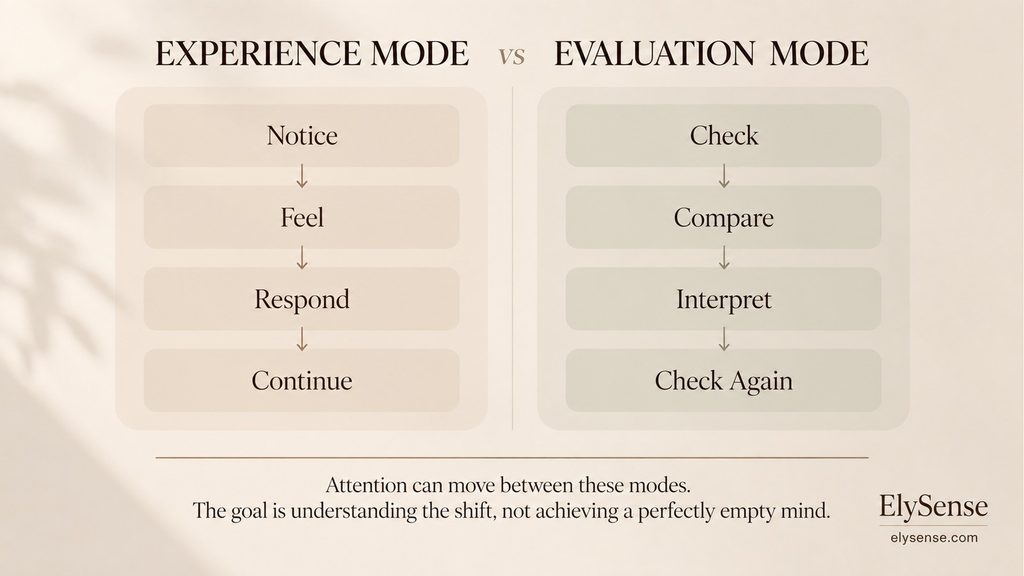
Experience mode and evaluation mode
“Experience mode” does not mean total absorption or a silent mind. It means attention is available for what is happening: sensation, emotion, connection, curiosity, preference, movement, or response. You might notice that something feels pleasant, neutral, distracting, uncomfortable, funny, or unfamiliar and continue responding to that information.
“Evaluation mode” is different. Attention begins checking the experience against a standard or anticipated verdict:
- Am I aroused enough?
- Do I look attractive from this angle?
- Is my partner disappointed?
- Am I taking too long?
- Should this feel better?
- What does this say about me or this relationship?
The content varies. The common feature is that attention is no longer only receiving information; it is grading what the information means.
Attention can move between these modes. A practical observation such as “that position hurts” or “I want more pressure” is not a failure of presence. It is useful information. Even a passing unrelated thought is not necessarily self-monitoring. The distinction lies in what attention is being asked to do—and whether checking begins to dominate the experience.
A thought is not a verdict
Suppose you notice, I’m distracted. That is an observation. It describes a moment.
The next thought might be, I should not be distracted; now I have ruined this. That is an evaluation. It turns momentary information into a conclusion about your performance or the whole experience.
The conclusion may then create a new task: fix the distraction, prove your attraction, recover arousal, reach an outcome, or conceal what is happening. Attention that was briefly elsewhere is now busy supervising itself.
Separating observation from judgment does not require you to approve of every experience. It simply lets you ask a clearer question: What did I notice, and what conclusion did I add?
Level 2 — Understand the Loop
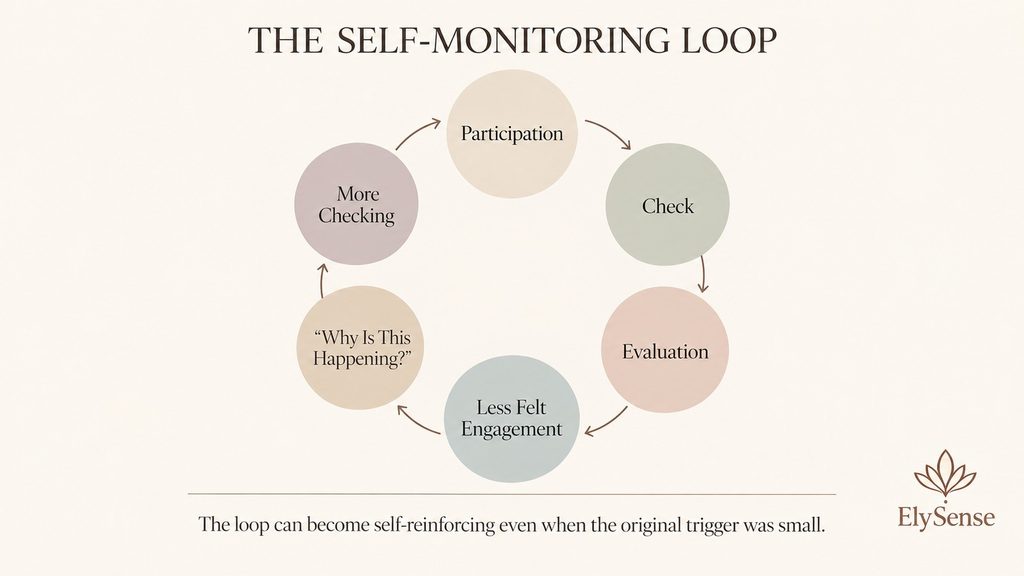
Self-monitoring can become a feedback loop. Something triggers a check. The trigger may be small—a pause, a change in sensation, a glance, a memory, awareness of time, or an expectation about what should happen.
Attention then turns toward evaluation: Is everything still working? Because some attention is now occupied with checking, the experience may feel less immediate. That change becomes fresh information: I feel less engaged than a moment ago. If it is interpreted as a warning or failure, checking intensifies.
The sequence can look like this:
- Something prompts a check.
- Attention shifts toward evaluation.
- The experience feels less immediate.
- You notice that change.
- You interpret the change as a problem.
- Monitoring increases.
Research on cognitive distraction and sexual functioning supports treating attention as relevant, but it does not establish one universal path or prove what is happening for any individual. Experimental and observational work has linked distraction or self-focused evaluation with aspects of sexual response and experience; much of this literature is limited by specific study populations, measures, and settings. The careful conclusion is that attention can matter—not that every sexual difficulty is caused by overthinking or that removing thoughts guarantees a particular outcome.
Context changes what the checking means
Outcome pressure may turn each sensation into evidence of whether orgasm is getting closer. Concern about a partner’s reaction may direct attention toward facial expressions or imagined disappointment. Body awareness may shift attention from how your body feels to how it looks. Time pressure may make every pause feel consequential. A previous difficult experience may make you watch for a repeat.
Solo and partnered experiences may also recruit attention differently. A familiar solo routine can involve fewer unknowns; a new partnered context can involve communication, interpretation, and uncertainty. That difference does not by itself mean a partner is the problem, a product has caused dependence, or one kind of sex is more valid than another.
These contexts are not interchangeable. A pattern connected with pain needs a different response from one driven mainly by a narrow outcome expectation. A safety concern is not a “presence” problem. Medication questions cannot be settled by an attention exercise. Context is not a detail added after the explanation; it is part of the explanation.
Level 3 — Explore Without Turning It Into Another Test
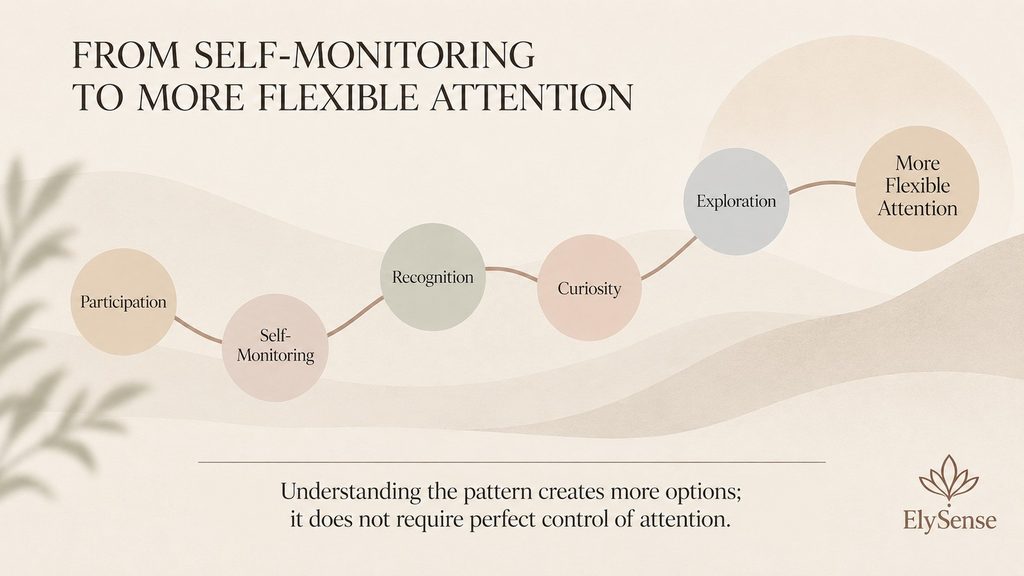
Exploration is most useful when it helps you learn, rather than creating a new standard you must meet. You do not need to complete every step during sex. You might reflect afterward, talk with a partner when appropriate, or choose one small point to notice next time.
Notice what attention is checking
Try making the check specific: timing, orgasm, arousal, appearance, a partner’s response, whether you are “doing enough,” or what the experience means. “I overthink everything” offers little room to learn. “I start checking the time when I think my partner is waiting” gives you context.
Separate the observation from the conclusion
Use two short sentences:
- Observation: “My attention moved to whether I was taking too long.”
- Conclusion: “I decided that meant I was disappointing my partner.”
The conclusion may be accurate, inaccurate, or unresolved. Naming it as a conclusion keeps it open to communication or further evidence rather than treating it as fact.
Reduce one outcome target
If the experience has become organized around a single result, consider loosening that target once. This is not a disguised technique for producing the result. It is a way to notice what changes when the experience is allowed to provide information besides success or failure.
For example, you might agree that there is no required endpoint, allow a pause without interpreting it, or treat a change in arousal as information rather than a score. Satisfaction, connection, and preference cannot be reduced to whether one expected event occurred.
Let a thought exist without assigning it a job
A thought does not always need to be removed, answered, or replaced. You may be able to notice, There is the timing thought, without beginning an internal investigation. If you then notice yourself checking whether you have successfully let it go, that is useful information too—not proof that you failed.
Compare contexts, not identities
You may notice that participation feels easier when there is more time, clearer communication, privacy, familiarity, a different kind of touch, less outcome pressure, or a greater sense of safety. Or you may not see a clear pattern yet.
Describe conditions before drawing conclusions about who you are, how attracted you are, or what your relationship means. “Monitoring was stronger when I felt rushed” is more precise than “I cannot be present.”
Change one thing at a time
Multiple simultaneous fixes can create more monitoring. A single, modest change—such as discussing timing beforehand or removing one expected outcome—makes it easier to learn what actually affected the experience. The aim is more flexible attention, not perfect control of attention.
Professional Boundary
General education cannot determine why this pattern is happening for you. Consider support from an appropriately qualified healthcare or mental-health professional when it causes persistent distress, affects your wellbeing, or occurs alongside pain, panic, trauma-related reactions, intrusive thoughts, medication concerns, or broader mental-health symptoms. A clinician can help consider physical, psychological, medication-related, and contextual factors without assuming one explanation.
Relationship safety concerns deserve direct attention rather than being reframed as an attention problem. If communication feels unsafe, coercion is present, or your boundaries are not respected, the priority is safety and support—not becoming better at staying engaged.
Occasional distraction or self-consciousness, by itself, does not establish a disorder. Professional support is an option for investigation and care, not a verdict about your experience.
ElySense Perspective
Your mind does not need to be empty for an experience to be meaningful.
The goal is not perfect presence. It is learning to recognize when attention has shifted from experiencing to evaluating—and responding with curiosity rather than adding another layer of judgment.
You can notice a sensation without scoring it. You can notice a thought without treating it as a conclusion. You can gather information about context without turning that information into an identity. And you can decide what, if anything, you want to explore next.
FAQ
Is thinking during sex automatically a problem?
No. Thoughts, memories, practical observations, and momentary distractions can all occur during sex. The more useful question is whether attention has shifted into repeated checking or evaluation in a way that changes the experience or causes distress. A thought is not automatically a problem, and noticing one is not evidence that you are failing to be present.
Does getting stuck in my head mean I am not attracted to my partner?
Not necessarily. Attention can shift for many reasons, including pressure, uncertainty, body awareness, time, discomfort, expectations, or concern about another person’s response. Attraction and attention are related in complex ways, but one episode of self-monitoring cannot establish how attracted you are. Notice the context and, where appropriate and safe, use communication rather than inference to understand a partner’s experience.
Is overthinking during sex the same as performance anxiety?
No conclusion can be made from that phrase alone. Performance-related worry may involve self-monitoring, but people can evaluate an experience for many reasons. “Overthinking” is a description, not a diagnosis. If anxiety is persistent, distressing, or present more broadly, a qualified professional can help assess it in context.
Can trying harder to stay present make me monitor myself more?
It can. “Be present” may become another performance instruction, followed by checks such as Am I present now? or Why is this not working? A less demanding starting point is to notice what attention is checking and distinguish the observation from the judgment that follows. This does not guarantee a change in arousal, orgasm, or satisfaction; it simply gives you clearer information.
What should I notice first if this keeps happening?
Start with the specific check: progress, timing, appearance, a partner’s reaction, discomfort, an outcome, or what the moment supposedly means. Then ask what happened just before it and what conclusion followed. You do not need to solve the pattern in real time. If pain, fear, intrusive thoughts, safety, medication effects, or ongoing distress are involved, consider appropriate professional support.
Continue Your Journey
- How Do I Know What Actually Feels Good? — Learn to observe and describe experience before turning sensation into judgment.
- Why Does It Take Me So Long To Orgasm? — Explore timing and outcome pressure without using orgasm as a performance score.
- Why Does One Experience Feel Like It Defines Me? — Explore how one experience can start carrying more meaning than the experience itself—and how to separate information from identity.