
How to understand whether the mismatch is about intensity, stimulation style, product fit—or simply personal preference.
Maybe you have already tried changing the setting.
You moved the vibrator to a different position. You used less pressure. You gave yourself more time. You may even have tried more than once because other people made it sound simple, natural, or almost universally enjoyable.
But instead of pleasure, you felt something else.
If the whole experience has felt disappointing or confusing, it may first help to understand why a vibrator does not always feel good before deciding what that experience says about your preferences.
The lowest setting still seemed too strong. Your body pulled away before you could think about it. The buzzing felt mechanical, irritating, ticklish, or emotionally distracting. Perhaps you could clearly feel the vibration, but it did not feel pleasurable. Maybe steady pressure, touch, or another kind of stimulation simply felt more natural.
When something that is widely praised does not work for you, it can become surprisingly personal.
You may start wondering whether you chose the wrong vibrator, whether you are using it incorrectly, or whether something is wrong with your body.
But there is another question worth asking:
Is the vibrator wrong for you—or is vibration simply not what your body prefers?
Quick Take
Not liking vibration is a valid experience.
Before deciding that every vibrator is wrong for you, it may help to identify what your body is actually responding to. The mismatch could involve intensity, directness, contact area, vibration quality, timing, emotional context, the particular product—or vibration itself.
You do not have to keep trying indefinitely to prove that your body works normally.
The goal is not to force a popular sensation to feel good. The goal is to understand what your response may be telling you.
Quick Answer
Yes, it can be completely normal not to like vibrators.
People do not all respond to the same sensations in the same way. Some enjoy vibration immediately. Some prefer a different intensity, rhythm, location, or style of stimulation. Others consistently prefer pressure, touch, movement, or non-vibrating experiences.
Not enjoying one vibrator does not automatically mean you dislike every kind of vibration. At the same time, you do not need to test every possible product before accepting that vibration may not be your preference.
One disappointing or uncomfortable experience is information—not a final verdict about your body.
Why Not Liking Vibration Can Feel So Personal
Vibrators Are Often Presented as Universally Effective
Vibrators are frequently described as if they are an almost automatic solution.
Reviews may call them life-changing. Friends or online discussions may suggest that everyone should own one. Beginner advice sometimes makes vibration sound like the easiest or most reliable path to pleasure.
These messages can create an expectation:
If it works for so many people, it should work for me too.
That expectation may feel harmless until your own experience is different.
Then the question can quietly shift from:
Do I like this sensation?
to:
Why can’t I make myself like it?
The first question is about preference.
The second turns preference into a personal failure.
When It Does Not Work, We Often Blame Ourselves
When a product does not feel good, there are several possible explanations.
The setting may be too intense. The contact may be too direct. The type of vibration may not suit you. The timing may be wrong. You may not feel relaxed, interested, or emotionally present. The product may simply be a poor match.
Yet many people skip over these possibilities and blame themselves first.
They may assume they are too sensitive, not sensitive enough, doing something incorrectly, or unable to respond “normally.”
If your first reaction is to question your technique, it may help to separate personal preference from the fear that you are using your vibrator wrong.
This self-blame can make exploration harder. Instead of noticing what the body is communicating, the person becomes focused on producing the expected result.
Preference Can Be Mistaken for Failure
A preference is simply a pattern in what feels more or less comfortable, pleasurable, natural, or welcome to you.
It is not an exam result.
Preferring pressure over buzzing does not mean your body is less responsive. Finding vibration distracting does not mean you are incapable of pleasure. Pulling away from intense stimulation does not automatically mean something is medically wrong.
Your response may reflect a mismatch.
The useful question is not:
Why am I failing at this?
It is:
What part of this experience is not fitting me?
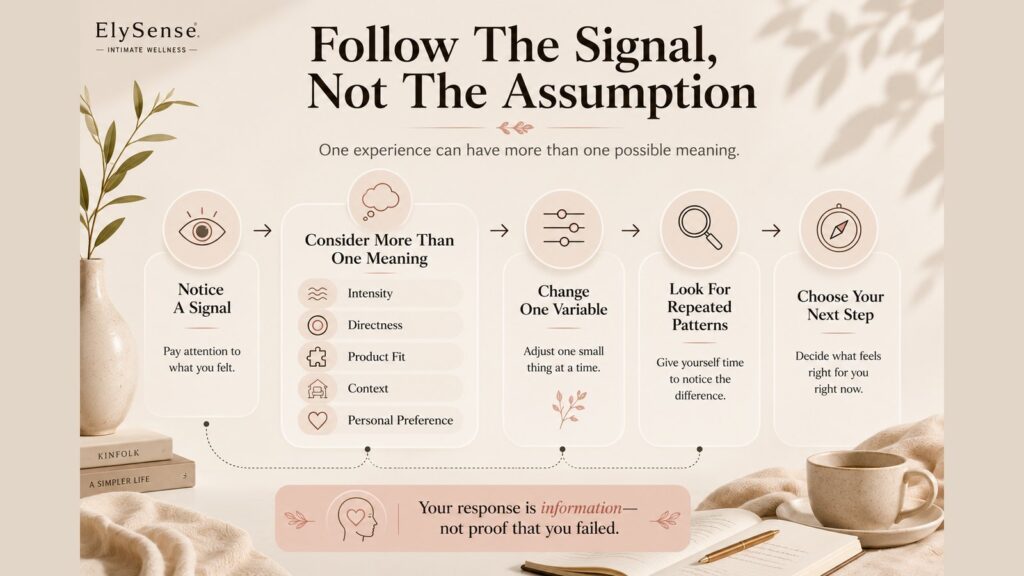
Start With the Signal, Not the Conclusion
Your first reaction can offer useful information, but it does not always tell you the full reason.
Try to notice the signal before deciding what it means.
Even the Lowest Setting Feels Too Strong
If the lowest setting feels immediately overwhelming, the issue may involve more than general “sensitivity.”
The stimulation may be too direct, too concentrated, or applied over too small an area. Some products also have a strong starting intensity even when they are technically on their lowest level.
The important information is not simply that the product feels “bad.”
It is that your body may be responding to the amount, concentration, or delivery of the sensation.
Your Body Automatically Pulls Away
Pulling away can happen before you consciously decide to stop.
For some people, this may mean the sensation became too intense too quickly. For others, it may reflect prolonged direct contact, a lack of control, an uncomfortable location, or a body that is simply not welcoming stimulation at that moment.
Pulling away does not automatically mean fear, dysfunction, or damage.
It may be your body setting a boundary before your thoughts have caught up.
You Can Feel It, but It Does Not Feel Pleasurable
Being able to detect vibration is not the same as experiencing pleasure from it.
You may feel buzzing clearly without feeling enjoyment, interest, or emotional connection. The sensation may register physically while still feeling neutral, distracting, or mechanical.
This may point toward location, context, stimulation quality, or personal preference.
It does not necessarily mean you are not sensitive enough.
Feeling vibration without pleasure is also different from the fear that you have permanently lost sensitivity from a vibrator.
It Feels Mechanical, Annoying, or Ticklish
Not every unpleasant sensation feels painful.
Vibration can sometimes feel irritating, ticklish, restless, numbing, overly repetitive, or emotionally impersonal. For some people, a high-pitched buzzing sensation feels very different from slower, broader, or more pressure-like stimulation.
These descriptions matter.
“Too strong,” “too buzzy,” “too sharp,” and “not pleasurable” are not always the same signal.
The more precisely you can describe the mismatch, the easier it becomes to understand your next step.
Pressure or Touch Feels More Natural
You may notice that steady pressure, movement, warmth, touch, or broader contact feels more comfortable than vibration.
That comparison can be especially useful.
Rather than asking only what you dislike, notice what your body seems to prefer instead.
Preference often becomes clearer through contrast.
The Same Signal Can Have More Than One Meaning
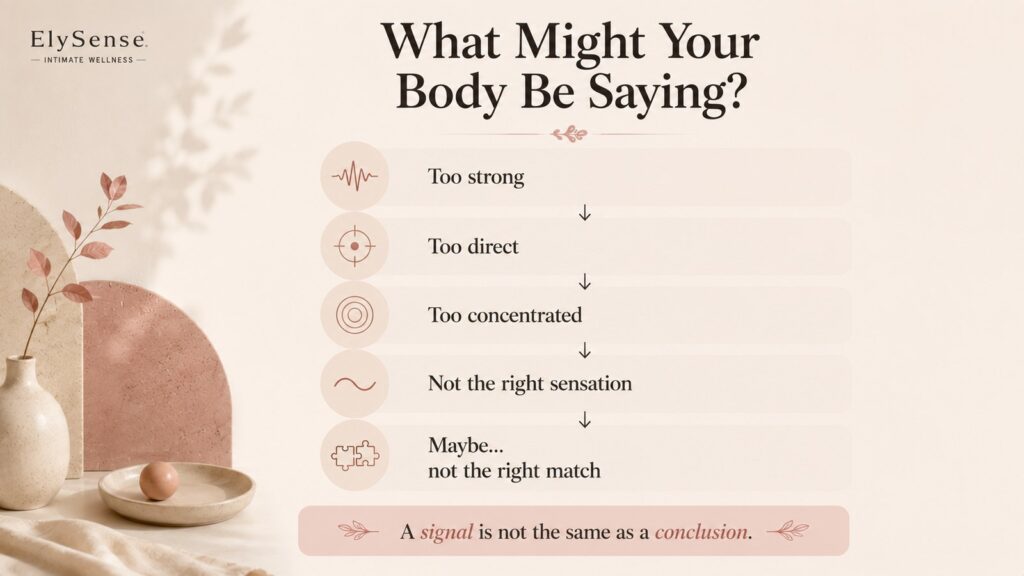
A single reaction can have several possible explanations. This is why it helps to avoid turning one experience into an immediate conclusion.
| What You Notice | What It May Point Toward |
|---|---|
| The lowest setting is still too strong | An intensity, directness, or contact-area mismatch |
| You pull away after a few moments | Too much duration, too little control, or stimulation that becomes overwhelming |
| You feel vibration without pleasure | Location, context, vibration quality, or personal preference |
| The buzzing feels irritating | A sensory-quality mismatch |
| Pressure or touch feels better | A preference for a different kind of stimulation |
These are possibilities, not diagnoses.
The same signal may mean different things in different situations. A sensation that feels uncomfortable one day may feel more acceptable in another context. A product that feels too direct in one position may feel less intense through clothing or broader contact.
At the same time, repeated patterns also matter.
If vibration consistently feels unpleasant across different settings and situations, that may be useful evidence of a genuine preference.
What Exactly Might Not Be the Right Fit?
It May Be This Particular Product
Not every vibrator creates the same experience.
Products can vary in:
- starting intensity;
- vibration depth;
- buzzing quality;
- shape;
- contact area;
- firmness;
- controls;
- and how easy they are to position.
A product can be popular and still be a poor match for you.
This does not necessarily mean the product is bad. It may simply create a sensory experience that does not suit your body.
A very small contact point may feel too concentrated. A strong motor may feel overwhelming. A product that is difficult to hold may leave you feeling less in control.
Sometimes the mismatch is narrow: this product, this shape, or this level of intensity.
If the pattern points toward a narrow product mismatch rather than vibration as a whole, understanding your preferred intensity, contact area, and sense of control can make choosing a vibrator more personal and less product-led.
It May Be the Way the Stimulation Is Delivered
The same vibrator may feel different depending on how directly it is used.
Direct contact can feel more intense than stimulation through fabric or over a wider area. Holding something firmly in one place may feel different from moving it. Longer contact may become irritating even if the first few seconds felt acceptable.
This does not mean there is one correct technique.
It means that delivery changes the experience.
If a sensation becomes more comfortable when it is less direct, shorter, broader, or easier to control, the mismatch may be about delivery rather than vibration as a whole.
It May Be the Quality of the Vibration
People often talk about vibration as if it were one single sensation.
It is not.
Some vibrations feel sharp and buzzy. Others feel deeper, slower, broader, or more like pulsing pressure. Two products set at a similar intensity can still feel very different.
A person may dislike one vibration quality while tolerating or enjoying another.
However, you do not need to turn this into a large product experiment. The point is simply to avoid assuming that one sensory quality represents every possible form of vibration.
It May Be the Timing or Context
Pleasure is influenced by more than the tool being used.
Interest, stress, privacy, emotional comfort, fatigue, medication changes, hormonal shifts, distraction, and physical tension can all affect how stimulation feels.
A sensation that might otherwise feel neutral can become irritating when you are rushed or tense. A body that does not currently want stimulation may experience even a low setting as intrusive.
This does not mean the response is “all in your head.”
Context is part of the body’s experience.
If vibration feels different depending on your mood, interest, comfort, or sense of control, the mismatch may not be stable across every situation.
It May Be a Genuine Preference
Sometimes the simplest explanation is also valid:
You may not enjoy vibration.
You may prefer pressure, touch, movement, fantasy, emotional connection, or another kind of sensory experience. You may enjoy some forms of stimulation and dislike others.
A genuine preference usually becomes clearer through repetition.
It does not have to be based on one disappointing attempt. But it also does not require years of testing.
If the same kind of sensation repeatedly feels unwelcome while other forms feel more natural, that pattern may be enough to guide your decision.
A Simple Way to Narrow It Down
You do not need a complicated testing system.
The purpose of exploration is to create clarity, not to turn pleasure into homework.
Change One Variable at a Time
If you choose to explore further, change only one part of the experience.
For example, you might change:
- intensity;
- location;
- directness;
- duration;
- pressure;
- timing;
- or whether the stimulation is moving or still.
Changing several things at once may make it harder to understand what affected the experience.
You are not trying to discover a perfect technique.
You are trying to identify the narrowest useful explanation.
Notice What Improves—and What Does Not
Pay attention to whether a small adjustment changes the experience.
Does less direct contact make it more comfortable?
Does a shorter duration help?
Does the sensation still feel mechanical even when the intensity is lower?
Does the experience remain neutral rather than pleasurable?
Improvement can offer information. Lack of improvement can also offer information.
Neither result is a failure.
Compare With What Already Feels Better
One of the most useful questions is:
What does my body already respond to more naturally?
Perhaps you prefer broader pressure. Perhaps movement feels better than stillness. Perhaps touch feels more connected and less mechanical. Perhaps stimulation only feels welcome when you are already relaxed and interested.
You do not have to begin from zero.
Your existing preferences can help you interpret what the vibration is missing.
Look for Repeated Patterns, Not One Perfect Experience
One experience can be affected by many temporary factors.
Repeated experiences may show a clearer pattern.
The goal is not to keep trying until one attempt finally “works.” It is to notice whether similar signals continue to appear.
For example:
- direct stimulation repeatedly feels too intense;
- buzzing repeatedly feels irritating;
- pressure consistently feels more natural;
- the experience changes significantly when you have more control;
- or vibration remains uninteresting across different contexts.
Patterns create understanding.
Perfection is not required.
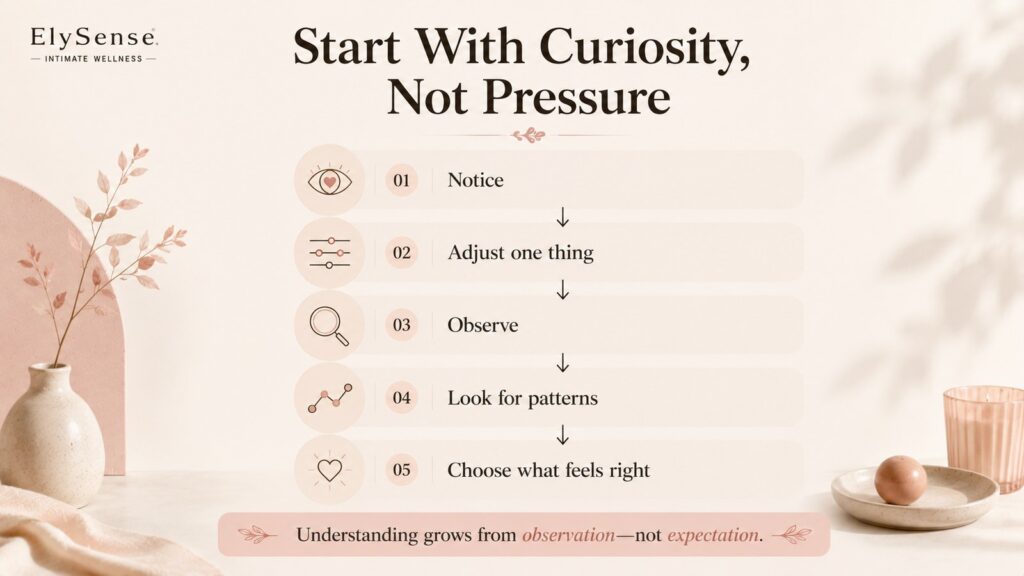
When It Is Okay to Stop Trying
Exploration Should Create Understanding, Not Pressure
Trying something more than once can sometimes clarify what you like.
But exploration stops being useful when it becomes an obligation.
If every attempt is driven by the thought that you must prove you can enjoy vibration, the process may create more pressure than understanding.
You are allowed to ask:
Am I still learning something, or am I only trying to meet an expectation?
That distinction matters.
You Do Not Need to Try Every Product Category
There are many vibrator shapes, motors, settings, and designs.
You do not need to test all of them before deciding that you are not interested in continuing.
It is reasonable to recognize uncertainty:
Maybe another kind would feel different.
It is also reasonable to say:
I understand enough for now, and I do not want to keep exploring this category.
Both positions can be thoughtful.
Repeated Discomfort or Irritation Is Useful Information
You do not need to push through repeated discomfort in the hope that your body will eventually accept the sensation.
Discomfort does not always indicate injury or a medical problem. But it still matters.
If your body repeatedly tenses, pulls away, becomes irritated, or loses interest, those responses can help guide you.
Comfort matters more than completing an experiment.
Preference Does Not Require a Defense
You do not need a clinical explanation for every preference.
You do not need to prove that vibration is objectively bad, that the product is defective, or that your body has an unusual sensitivity.
Sometimes “I do not enjoy this” is enough.
A preference can remain open to change without being treated as invalid today.
You can decide that vibration is not for you right now. You can revisit it later. You can also never revisit it.
None of those decisions means you failed.
When It May Be Worth Looking Beyond Preference
Not enjoying vibration by itself is not a medical diagnosis.
However, it may be helpful to speak with a qualified healthcare professional if the experience includes symptoms that go beyond ordinary preference or product mismatch.
Consider seeking guidance if you experience:
- persistent or significant pain;
- bleeding;
- skin injury or irritation that does not settle;
- a sudden, unexplained change in sensation;
- long-lasting loss of sensation across different situations;
- changes that began around the same time as a medication change or other symptoms;
- or ongoing distress that affects your well-being or relationships.
These signs do not automatically mean something serious is wrong.
They simply deserve more individualized attention than an educational article can provide.
A healthcare professional can help consider physical, neurological, hormonal, medication-related, skin-related, or emotional factors when appropriate.
The ElySense Perspective
Your body’s response is not an exam result. It is information.
You are allowed to adjust the input.
You are allowed to change the kind of stimulation.
You are allowed to decide that a particular product is not a match.
You are allowed to explore non-vibrating experiences.
You are allowed to pause.
And you are allowed to stop.
Products should adapt to people. People should not have to train themselves to tolerate a product simply because it is popular.
Understanding the narrowest mismatch can help you make a clearer decision:
- Is the intensity wrong?
- Is the contact too direct?
- Is the vibration quality unpleasant?
- Is the context affecting the experience?
- Is this particular product a poor fit?
- Or is vibration simply not your preference?
You do not need to force an answer immediately.
But you also do not need to force the sensation.
Frequently Asked Questions
Is it normal not to like vibrators?
Yes. People respond differently to different sensations, and not everyone enjoys vibration. Disliking it does not automatically mean something is wrong with your body.
How do I know whether it is the vibrator or vibration itself?
Notice what changes when you adjust one variable, such as intensity, directness, duration, or location. If the experience improves, the mismatch may be specific. If vibration remains consistently unpleasant across different situations, it may reflect a broader preference.
Should I keep trying different vibrators?
Only if you are genuinely curious and the process still feels comfortable. You do not need to buy or test multiple products to prove anything. Exploration should create understanding, not pressure.
Can I prefer pressure or touch instead of vibration?
Yes. Pressure, touch, movement, and vibration are different sensory experiences. Preferring one over another is a normal form of personal preference.
Does pulling away mean something is wrong?
Not necessarily. Pulling away may occur when stimulation feels too intense, too direct, prolonged, unexpected, or unwanted in that moment. Persistent pain, injury, or broader changes in sensation deserve professional attention.
When should I talk with a healthcare professional?
Consider speaking with a healthcare professional if you experience persistent pain, bleeding, skin injury, sudden changes in sensation, long-term numbness across different situations, medication-related changes, or significant ongoing distress.
Continue Your Journey
Understanding your response is only the beginning. Depending on what feels most relevant to you, here are three next steps that can help you continue exploring with more clarity—and less pressure.
If you’re still wondering why the experience doesn’t feel good…
Why Doesn’t My Vibrator Feel Good?
Not every disappointing experience means something is wrong with your body. Learn how comfort, expectations, product fit, and context can all shape how vibration feels.
→ Read: Why Doesn’t My Vibrator Feel Good?
If you’re worried that you’re using it incorrectly…
Am I Using My Vibrator Wrong?
Many people assume they’re making a mistake when something doesn’t feel right. This guide explores why there isn’t one “correct” way to use a vibrator—and how paying attention to your own comfort can be more helpful than chasing perfect technique.
→ Read: Am I Using My Vibrator Wrong?
If you think the product itself may not be the best match…
How to Choose Your First Vibrator
Sometimes the question isn’t whether vibrators are right for you—it’s whether this particular one is. Learn how factors like intensity, contact area, control, and comfort can help you choose a product that better fits your preferences.
→ Read: How to Choose Your First Vibrator
One Big Idea
Your response is information—not proof that you failed.
Reader Takeaway
You do not need to force yourself to enjoy a popular sensation.
Start by noticing what your body is actually responding to. The mismatch may involve intensity, directness, vibration quality, product fit, context, or genuine preference.
You can adjust one variable, change direction, pause, or stop.
Any of those choices can be a thoughtful response.
You do not need to enjoy vibration to prove that your body works.