

You can want a sexual experience and still notice that your body is not responding in the way—or at the pace—you expected. You might feel mentally interested but not subjectively “turned on.” You might feel aroused without noticing the genital response you associate with arousal. Or your body might respond while your interest, comfort, or willingness is absent.
When those signals seem to disagree, the mismatch can quickly become a verdict: Maybe I do not really want this. Maybe I am not attracted enough. Maybe my body cannot be trusted. Maybe something is wrong with me, my relationship, or my identity.
Those conclusions are larger than the information available. Wanting or interest, subjective arousal, and physical or genital response are related, but they are not interchangeable readings of one hidden truth. They can overlap without always moving together.
So which signal should you trust? You do not have to appoint one signal as the judge of all the others. A more useful question is: What information is each signal actually giving me?
Quick Take
- Wanting or interest can tell you that an experience, person, possibility, or kind of connection appeals to you. It does not guarantee a particular feeling or bodily response.
- Subjective arousal is your felt experience of being sexually activated or turned on. It does not, by itself, prove what you want to do.
- Physical or genital response is a bodily event. It does not automatically prove desire, preference, attraction, or consent—and its absence does not automatically disprove them.
- A mismatch is real information, but it is not a complete explanation. Understanding comes before interpretation; interpretation comes before deciding what you want to do next.
Quick Answer
If you want sex mentally but your body does not seem to respond as expected, you can trust that you noticed both signals. Your interest is information. Your bodily response—or lack of the response you expected—is also information. Neither has to expose the other as false.
Research distinguishes a person’s reported experience of arousal from measured genital response because the two do not always correspond fully. That evidence supports a limited but important conclusion: a mismatch can happen. It does not tell you, from the mismatch alone, why it happened or what it means about your attraction, orientation, relationship, health, or identity.
For decisions about sexual activity, willingness, comfort, boundaries, and consent matter. A physical response is never permission. An absent physical response is not automatic proof that your interest was imaginary. The next step is not to force the signals into agreement; it is to understand what each one can—and cannot—answer.
Level 1 — Name the Three Signals
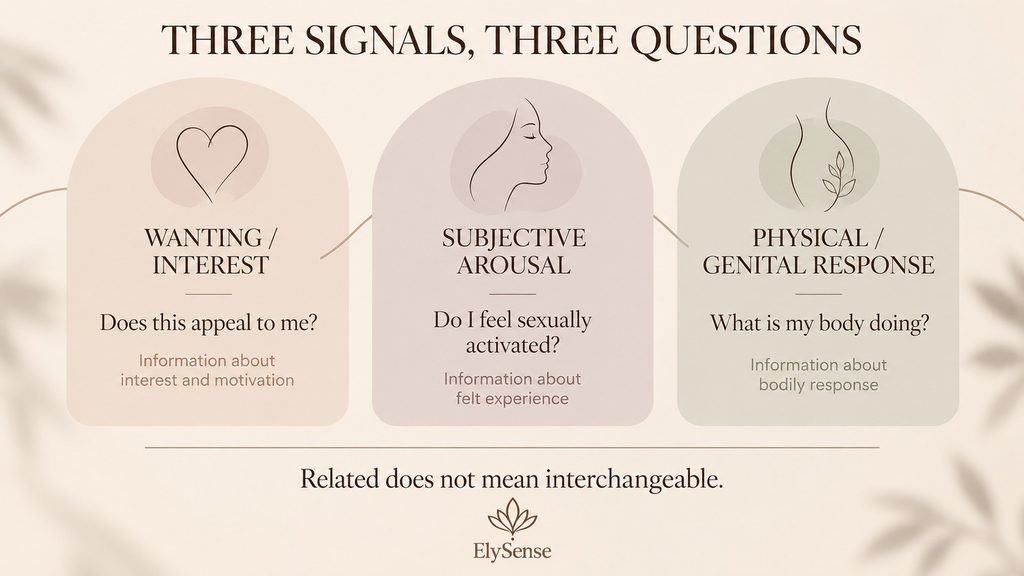
1. Wanting or interest: “Does this appeal to me?”
Wanting can include curiosity, anticipation, attraction, openness, or a wish for a sexual experience. Sometimes it feels urgent; sometimes it is quiet. You may want closeness, touch, pleasure, exploration, or a particular activity without already feeling strongly aroused.
Wanting answers something like: Do I have interest in moving toward this? It can help you recognize preference and motivation. But it cannot promise that your subjective arousal will rise, that your body will respond on schedule, or that you will continue wanting the experience once it begins.
Interest is allowed to coexist with uncertainty. It is also allowed to change. Wanting something at one point does not obligate you to continue, and wanting the idea of an experience does not require you to enjoy every part of its reality.
2. Subjective arousal: “Do I feel sexually activated?”
Subjective arousal is the experience you recognize from the inside: feeling turned on, sexually engaged, excited, receptive, or activated. It is a felt state rather than an external measurement.
Subjective arousal can tell you about your experience in that moment. It cannot, by itself, establish consent or commitment to an activity. You can feel aroused and still not want what is happening. You can also want an experience without yet feeling distinctly aroused.
The words available for this signal may be imperfect. “Aroused,” “interested,” “excited,” and “ready” can blur together in everyday language, but separating them can make your experience easier to interpret.
3. Physical or genital response: “What is my body doing?”
Physical or genital response can include changes in lubrication, erection, genital blood flow or sensitivity, muscle tension, heart rate, breathing, warmth, and other bodily shifts. No single response stands in for the whole category, and lubrication is not the article’s central test.
This signal can tell you that a bodily process is occurring, changing, delayed, subtle, or not currently noticeable. It cannot independently tell you what you want, whether you like a person or activity, whether you consent, or what the response means about your identity.
Bodies can respond without desire or consent. Bodies can also fail to show an expected response while interest or attraction is present. Treating the body as a lie detector asks a physical event to answer a question it cannot answer on its own.
Level 2 — Interpret the Mismatch Without Creating a Verdict
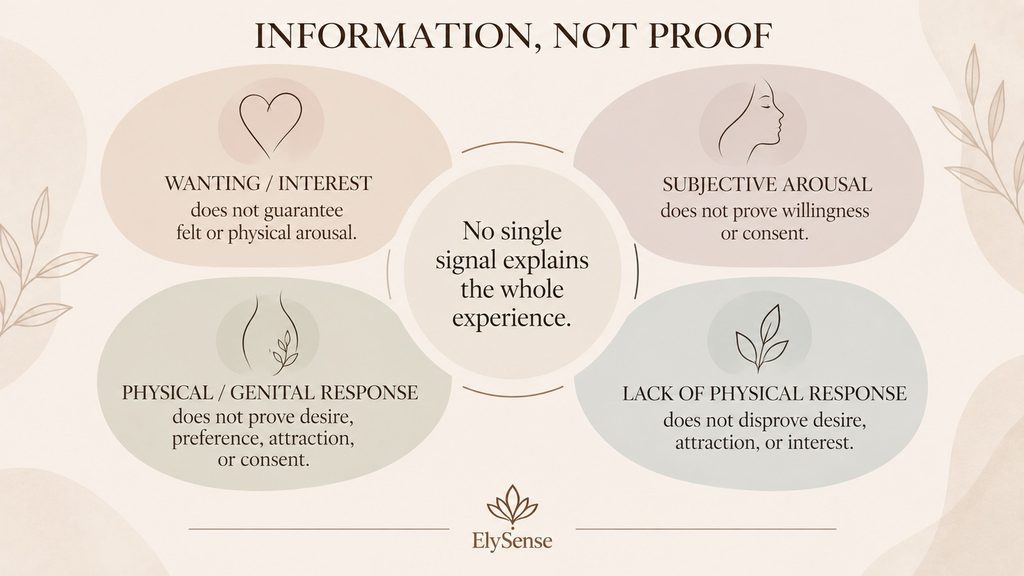
Agreement is possible; perfect alignment is not required
Sometimes wanting, subjective arousal, and physical response align: I want this, I feel aroused, and I notice my body responding. That alignment may feel easy to interpret. At other times, two signals may align while the third does not, or all three may seem to offer different information.
The mismatch itself is an observation. The trouble often begins when the observation is made to carry a conclusion it cannot support:
- Observation: “I want this, but I do not notice the physical response I expected.”
- Unsupported conclusion: “Then I cannot really want it.”
- Observation: “My body responded, but I do not want this experience.”
- Unsupported conclusion: “Then some part of me must want it.”
- Observation: “I feel aroused, but I do not want to continue this particular activity.”
- Unsupported conclusion: “Arousal means I should keep going.”
In each case, one signal is being promoted into a verdict over the others. A more accurate interpretation keeps the information separate long enough to understand it.
What mismatch can tell you
A mismatch can tell you that the three signals are not fully aligned right now. It may tell you that your expectation of how they “should” travel together does not match your present experience. If a pattern repeats, that repetition may be worth observing and discussing.
That is meaningful information. It may influence what you choose next: pause, continue, change the activity, communicate, allow more time, stop, reflect later, or seek professional input if the experience is persistent or distressing.
But mismatch alone does not identify a cause. It does not establish trauma, hormones, medication effects, menopause, ADHD, attraction or lack of attraction, sexual orientation, relationship quality, or a medical or psychological disorder. Any of those topics would require information beyond the mismatch itself and, where appropriate, individualized professional assessment.
Consent is not an arousal test
Consent is an active, contextual agreement—not a conclusion drawn from genital response. A physical reaction cannot volunteer you for an activity, override a “no,” or establish enjoyment. This matters especially when a bodily response feels confusing or unwanted: the response does not rewrite your preference or boundary.
The reverse boundary matters too. Wanting and consent do not guarantee a specific physical response. If your body is not responding as expected, you do not need to use that absence as evidence against your stated interest. You can still decide that an activity is uncomfortable, impractical, or not right for you in that moment, but that decision belongs to you; it is not automatically dictated by one bodily sign.
Level 3 — Use the Signals to Make a Decision Without Forcing Agreement
Understanding the distinction does not require you to ignore your body or talk yourself past discomfort. It gives you more precise information for agency. Instead of asking one signal to deliver a final verdict, you can ask several smaller questions.
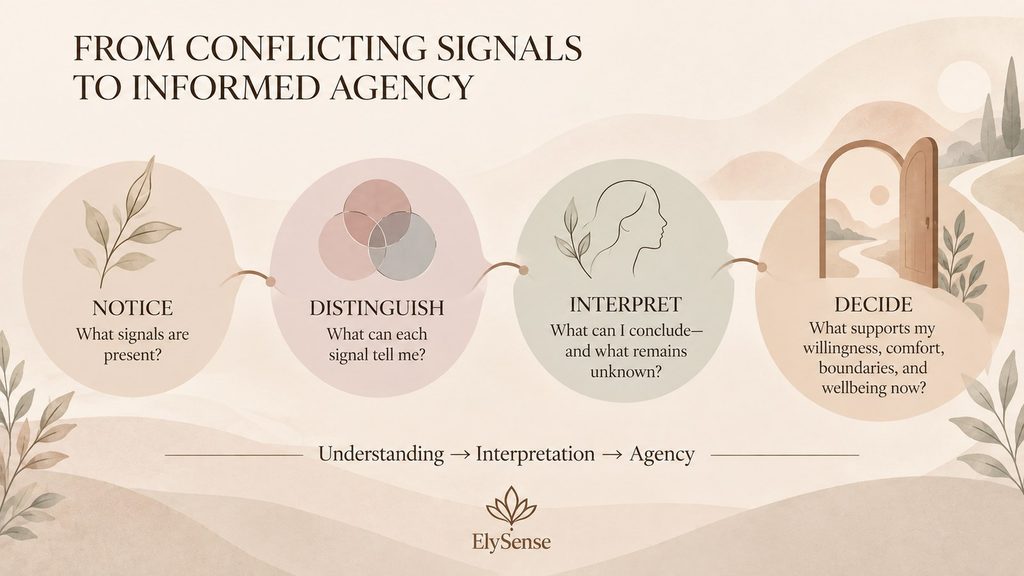
Start with observation
Describe what is present without filling in the cause:
- “I am interested in this.”
- “I do not feel very aroused yet.”
- “I expected a stronger physical response than I notice.”
- “My body is responding, but I do not want this activity.”
Specific descriptions make room for several truths at once. They also reduce the pressure to settle questions about attraction, health, relationship, or identity in the middle of one experience.
Ask each signal only the question it can answer
Ask wanting: Does this appeal to me? Do I want to move toward it now?
Ask subjective experience: What am I feeling? Is there pleasure, arousal, neutrality, discomfort, uncertainty, or something harder to name?
Ask physical response: What bodily changes do I notice? Is anything uncomfortable? Is the activity workable for my body as it is right now?
Then ask the decision question separately: Given all of this information, what do I want to do next?
That decision might be to continue, slow down, change course, communicate, add practical support, pause, or stop. None is a required “solution” to mismatch. Agency means responding to the whole situation, not making your body prove your interest or making your interest overrule your body.
Separate comfort from meaning
A physical response can have practical implications without carrying an identity-level message. If an activity feels uncomfortable, comfort deserves attention whether or not you feel desire. Changing or stopping the activity does not concede that your desire was false; it responds to the information available now.
Likewise, making a practical adjustment does not explain the mismatch. It may simply make the present experience more workable. You do not need a grand conclusion before honoring comfort or a boundary.
Look for a pattern without turning it into a diagnosis
If you want to understand the experience over time, notice when each signal appears, how it changes, what you expected, whether the mismatch causes distress, and what decisions felt supportive. Compare experiences rather than searching for a single hidden cause.
A pattern can give you better questions. It still does not diagnose you. “I have noticed this several times and want to understand it” is a grounded reason to speak with a qualified professional; “this signal proves what is wrong” is not.
Let unresolved information remain unresolved
Sometimes the most accurate conclusion is: These signals did not align, and I do not yet know why. Uncertainty can feel unsatisfying, but it is safer than assigning a cause the evidence cannot support.
You can make a present-tense decision without solving the entire meaning of the experience. You can stop because you do not want to continue. You can continue because you are interested and comfortable, while remaining free to change your mind. You can seek more information because the pattern matters to you. The decision does not require all three signals to match first.
Professional Boundary
This article can clarify categories of experience; it cannot determine the cause of a mismatch for an individual. Consider speaking with an appropriately qualified healthcare professional or sex therapist if the pattern is persistent, new, distressing, painful, or affecting your wellbeing or sexual choices. Professional support can consider your full context rather than diagnosing from one signal.
Seek timely medical care for sudden or concerning physical changes, pain, bleeding, injury, or other symptoms that worry you. If medication, hormonal, or health questions are already part of your situation, discuss them with an appropriate clinician rather than changing treatment on the basis of this article.
If any sexual activity is pressured, unwanted, coercive, or unsafe, the priority is your boundaries and safety. A bodily response never turns an unwanted experience into consent.
ElySense Perspective
You do not have to decide which signal is “telling the truth.”
Wanting, felt arousal, and physical response describe different parts of an experience. Respecting those differences is not distrusting your body or dismissing your mind. It is a more precise form of self-trust: noticing what each signal says, refusing to make it prove more than it can, and keeping the authority to decide what happens next.
A mismatch can be confusing without being a verdict. Observation can remain observation. Information can remain information. And uncertainty can remain open while you choose what supports your comfort, boundaries, curiosity, and wellbeing now.
FAQ
Can I want sex even if I am not physically responding?
Yes, wanting or interest and physical response are distinct signals, so a lack of the response you expected does not automatically disprove your interest. It may still matter practically—for example, if something feels uncomfortable—and a persistent or distressing change may be worth discussing with a qualified professional. What it does not do by itself is explain the cause or settle what you want.
Does physical arousal mean I secretly want what is happening?
No. A physical or genital response does not automatically prove desire, preference, enjoyment, or consent. Bodily response is information about a bodily event, not permission and not a hidden vote that overrules what you want or say.
Is subjective arousal the same as desire?
Not exactly. Desire or interest concerns whether an experience appeals to you or whether you want to move toward it. Subjective arousal is the felt experience of being sexually activated. They can occur together, but either can be present without the other.
Why is my mind interested when my body is not responding?
The mismatch alone cannot identify why. It establishes only that your interest and the physical response you expected are not fully aligned at that moment. Trauma, hormones, medication, menopause, ADHD, attraction, orientation, relationship quality, and medical or psychological disorders cannot be inferred from that observation alone. If the pattern is persistent, changed, painful, or distressing, a qualified professional can help assess it in context.
Does a lack of lubrication mean I am not attracted to my partner?
No conclusion about attraction can be drawn from lubrication alone. Lubrication is one physical response, not a measurement of the whole experience and not a relationship verdict. Notice your interest, felt experience, comfort, and broader context separately; seek clinical guidance if a physical change or discomfort concerns you.
What should I trust when my signals conflict?
Trust that each signal reports a different kind of information. Your wanting tells you about interest; subjective arousal tells you about felt activation; physical response tells you what your body is doing. Then make a separate choice based on willingness, comfort, boundaries, and the full context. No single signal has to invalidate the others.
Continue Your Journey
- Why Does One Experience Feel Like It Defines Me? — Separate what happened from the larger conclusions it may seem to demand about you.
- Why Does It Take Me So Long to Orgasm? — Examine timing and outcome expectations without turning response into a performance score.
- How Do I Know What Actually Feels Good? — Build a more descriptive relationship with sensation, preference, and self-trust.