

Understanding What Time Really Means
If it feels like orgasm takes longer for you than it seems to for everyone else, you’re not alone.
Maybe you have seen someone describe orgasm as quick and effortless. Maybe a partner reaches it sooner than you do. Or perhaps you have simply started noticing the time—and wondering what that time says about you.
Am I normal?
Is something wrong with me?
Am I disappointing my partner?
Will it always be like this?
These questions can make a private experience feel like a test you are taking without knowing the rules.
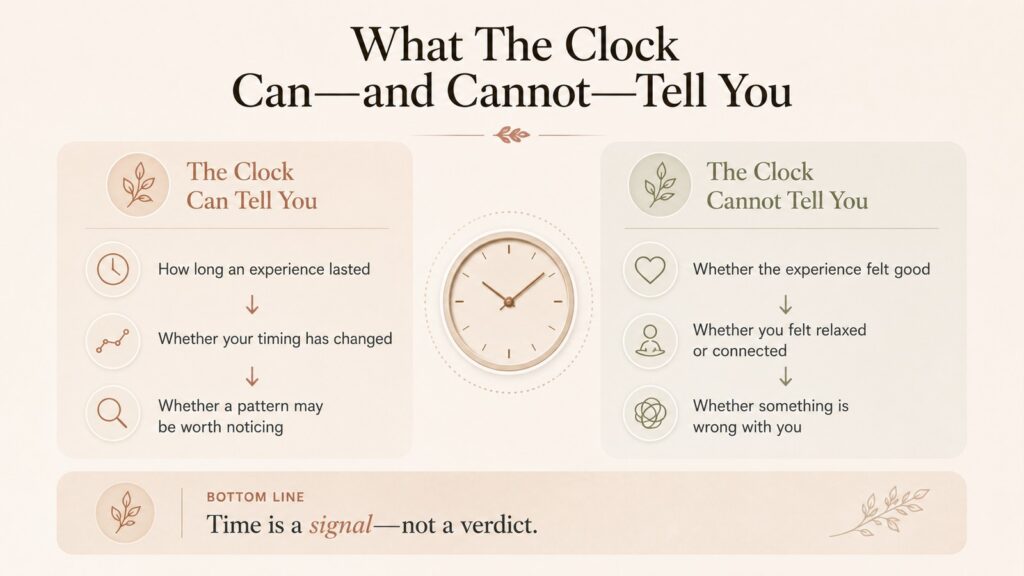
But time alone cannot explain what is happening.
It cannot tell you how comfortable you felt, whether your mind was present, what kind of stimulation worked for you, or whether the experience was satisfying.
To understand your experience, it may help to look beyond the clock.
Quick Take
Taking longer to orgasm does not automatically mean that something is wrong with your body.
More often, it means there are more pieces of the story than the clock can show.
Quick Answer
There is no single amount of time that everyone should take to reach orgasm.
Sexual response can vary between people and from one experience to another. Comfort, stress, privacy, fatigue, emotional connection, medication, health changes, and the type of stimulation involved may all influence what happens.
Some people usually reach orgasm quickly. Others need more time. Some notice that their timing changes depending on the situation.
The number of minutes can be useful information, especially when something has changed. But it is not, by itself, a diagnosis or a score.
Instead of asking whether your experience matches someone else’s timeline, a more useful question may be:
What does my experience feel like, and has anything meaningful changed?
Why This Question Feels So Personal
Most people do not begin by timing themselves.
The clock often becomes noticeable only after comparison enters the experience.
You may hear someone say that orgasm happens for them within minutes. A partner may finish before you. A movie, tutorial, or online conversation may make sexual response appear predictable and effortless.
Even when no one directly criticizes you, a quiet expectation can begin to form:
This should happen faster.
Once that expectation is present, taking longer may begin to feel like evidence.
You may interpret it as evidence that your body is difficult, that you are doing something incorrectly, or that you are somehow less responsive than other people.
But the clock itself is not what creates this feeling.
It is the meaning we gradually attach to it.
Two people could take the same amount of time and understand the experience completely differently.
One may feel relaxed, satisfied, and unconcerned.
The other may feel watched, pressured, or afraid of disappointing someone.
One measures time.
The other feels measured by time.
That difference matters.
When Time Becomes A Judgment
Time is neutral.
It can tell you that an experience lasted five minutes, twenty minutes, or longer. It can help you notice whether something has changed. It may reveal a pattern worth understanding.
But time cannot tell you:
You are too slow.
Your body is failing.
You are disappointing someone.
Everyone else is doing better.
The number never says these things.
We do.
A neutral observation can slowly become a personal judgment:
It took a long time.
becomes:
I take too long.
and then:
Something must be wrong with me.
At that point, curiosity becomes evaluation.
Awareness becomes performance.
Enjoyment becomes comparison.
That pressure may make it harder to remain present in the experience. Instead of noticing what feels comfortable, you may begin monitoring whether you are getting closer. Instead of responding naturally, you may feel responsible for producing a result.
Time works best as a signal—not as a verdict.
It may help you notice a change or ask a better question. But it cannot explain the whole experience on its own.
Taking longer is not the same as being unable to orgasm. If your concern is that orgasm rarely happens—or does not happen at all—the more useful question may be why orgasm feels difficult to reach.
Looking Beyond The Clock
When timing becomes the main focus, other useful information can disappear.
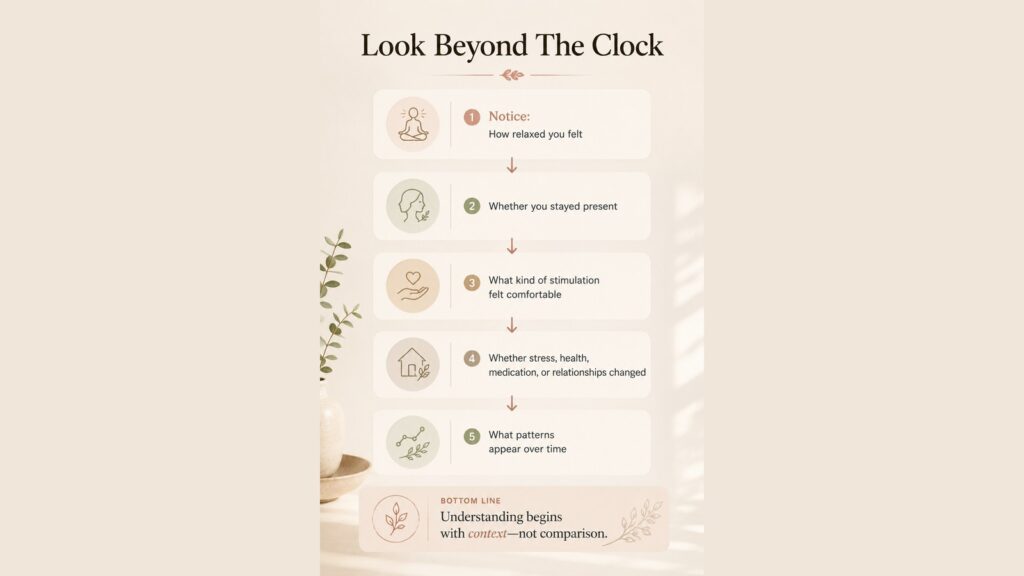
A better understanding often begins by noticing the context around the experience.
You might consider:
Did I feel relaxed or rushed?
Did I feel private and emotionally safe?
Was I mentally present, or was part of me watching and evaluating?
Was I tired, stressed, distracted, or worried?
Did the type of stimulation match what felt good for me?
Did I feel comfortable communicating what I wanted?
Has my response changed recently, or has it generally been consistent?
Do different situations produce different experiences?
Your own experience is worth observing with the same curiosity you might bring to anyone else’s.
For example, taking longer when you are tired may tell a different story from taking longer after starting a medication. Taking longer with a partner may mean something different from taking longer alone. A gradual pattern may deserve a different response from one isolated experience.
You may also notice that timing changes depending on the type of stimulation. For some people, orgasm is much more reliable with vibration, which can raise a different question: is it normal to only orgasm with a vibrator?
These observations do not necessarily point to a problem.
They point to understanding.
Sometimes the most useful clue is not how long orgasm takes, but whether the stimulation matches your body. Some people also discover that they orgasm reliably with a vibrator but not in other situations. That difference can be information without automatically being a problem.
Time measures duration.
Understanding requires context.
Your Rhythm Does Not Need To Match Someone Else’s
Averages can sometimes help describe groups.
They are much less useful for deciding what one person’s body should do.
Someone else’s experience may be real without becoming a standard you are required to follow.
They may have different preferences, stimulation, health, privacy, emotional comfort, relationship dynamics, or expectations. Even the same person may respond differently from one day to another.
That is why your personal baseline often matters more than someone else’s average.
Your baseline is not a perfect number. It is the pattern you begin to recognize across your own experiences.
Perhaps you usually need time to settle mentally before physical sensations become absorbing.
Perhaps you respond differently alone than with a partner.
Perhaps certain kinds of stimulation feel reliable while others do not.
Perhaps orgasm takes longer, but the experience still feels comfortable and satisfying.
None of these observations needs to be defended simply because it differs from someone else’s experience.
Confidence rarely comes from matching another person’s timeline.
It grows from understanding your own.
Your rhythm is not something you have to defend.
It is something you first need to understand.
Knowing When To Be Curious—Not Afraid
Reassurance does not mean ignoring every concern.
It means learning to respond to information without turning immediately toward fear.
Curiosity asks:
Has something changed?
Fear asks:
What is wrong with me?
Curiosity notices patterns.
Fear reaches conclusions from one moment.
One experience is a moment.
A pattern is information.
A longer timeline may simply be part of your usual response, especially when it has been consistent and the experience remains comfortable and satisfying.
If you have started wondering whether relying on one familiar method is changing your response, that concern deserves its own careful distinction. You can explore what vibrator dependence really means—and what it does not automatically mean..
It may be worth looking more closely when you notice:
- a clear or persistent change from your usual experience;
- new difficulty reaching orgasm when this was not previously a concern;
- pain, numbness, discomfort, or reduced sensation;
- a change that began after starting or changing medication;
- distress that affects your well-being or relationship;
- or a concern that continues even after pressure and comparison are reduced.
Medication, health, hormonal changes, emotional well-being, and relationship context may all be relevant. A healthcare professional can help you explore a meaningful change without requiring you to assume the worst.
Do not stop or change prescription medication without speaking with the clinician who prescribed it.
The goal is not to choose between dismissing your experience and becoming afraid of it.
There is another option:
Notice it.
Understand the context.
Then decide whether anything actually needs to change.
Better decisions usually begin with better observation—not faster conclusions.
A Different Way To Think About Time
Your experience cannot be understood by the clock alone.
Time may tell you how long something took.
It cannot tell you whether you felt comfortable.
It cannot tell you whether the experience was meaningful or satisfying.
It cannot tell you whether your body is wrong.
Once time stops acting like a score, it can return to being what it was all along:
one piece of information.
You can notice it without obeying it.
You can remain curious without blaming yourself.
You can compare today with your own patterns instead of comparing your body with someone else’s expectations.
And from that understanding, you can decide calmly whether anything needs attention—or whether your experience simply has its own rhythm.
Confidence.
Not because your experience finally matches someone else’s—
but because it finally makes sense to you.
Frequently Asked Questions
How long does it usually take a woman to orgasm?
There is no single amount of time that applies to everyone. Experiences vary depending on the type of stimulation, emotional comfort, stress, privacy, health, relationship dynamics, and individual differences. Rather than treating an average as a target, it is usually more helpful to understand what is typical and satisfying for your own body.
Is it normal if it takes me 30 minutes or longer?
It can be. Taking longer to orgasm does not automatically mean something is wrong. If your experience has generally been similar and remains comfortable and satisfying, the number of minutes alone may not be a reason for concern. A sudden or persistent change, pain, reduced sensation, or significant distress may be worth discussing with a healthcare professional.
Can stress make it take longer to orgasm?
Yes. Stress, anxiety, fatigue, distraction, and difficulty remaining mentally present may all influence sexual response. For many people, emotional and mental context can be just as important as physical stimulation.
Can medications affect orgasm timing?
They can. Some medications, including certain antidepressants and other prescription drugs, may affect sexual response for some people. If you notice a meaningful change after beginning or adjusting a medication, speak with the healthcare professional who prescribed it before making changes yourself.
Should I compare my experience with other people’s?
Usually not. Other people’s experiences rarely include all the context that shaped them. What works for one person may not reflect what is typical for another. Observing your own patterns over time is generally more useful than measuring yourself against someone else’s timeline.
Your Journey
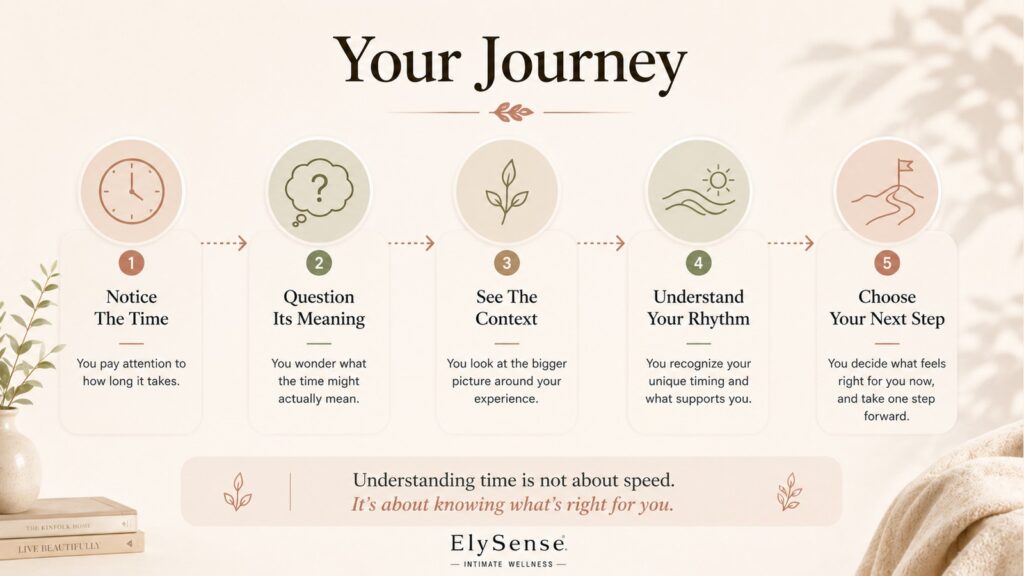
Notice The Time
↓
Question Its Meaning
↓
See The Context
↓
Understand Your Rhythm
↓
Choose Your Next Step
Continue Your Journey
Trying to understand why orgasm happens more reliably with a vibrator?
Explore:
Is It Normal to Only Orgasm With a Vibrator?
Wondering whether the concern is about timing—or difficulty reaching orgasm at all?
Explore:
Concerned that one reliable way of reaching orgasm means dependence?
Explore:
Can You Become Too Dependent on a Vibrator?